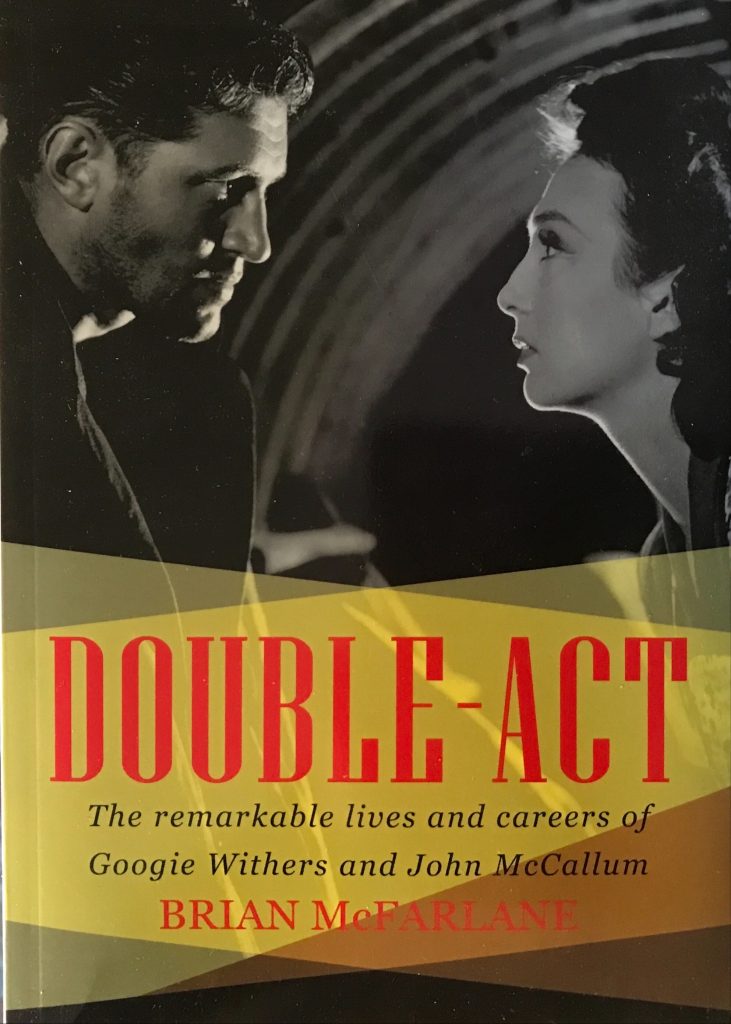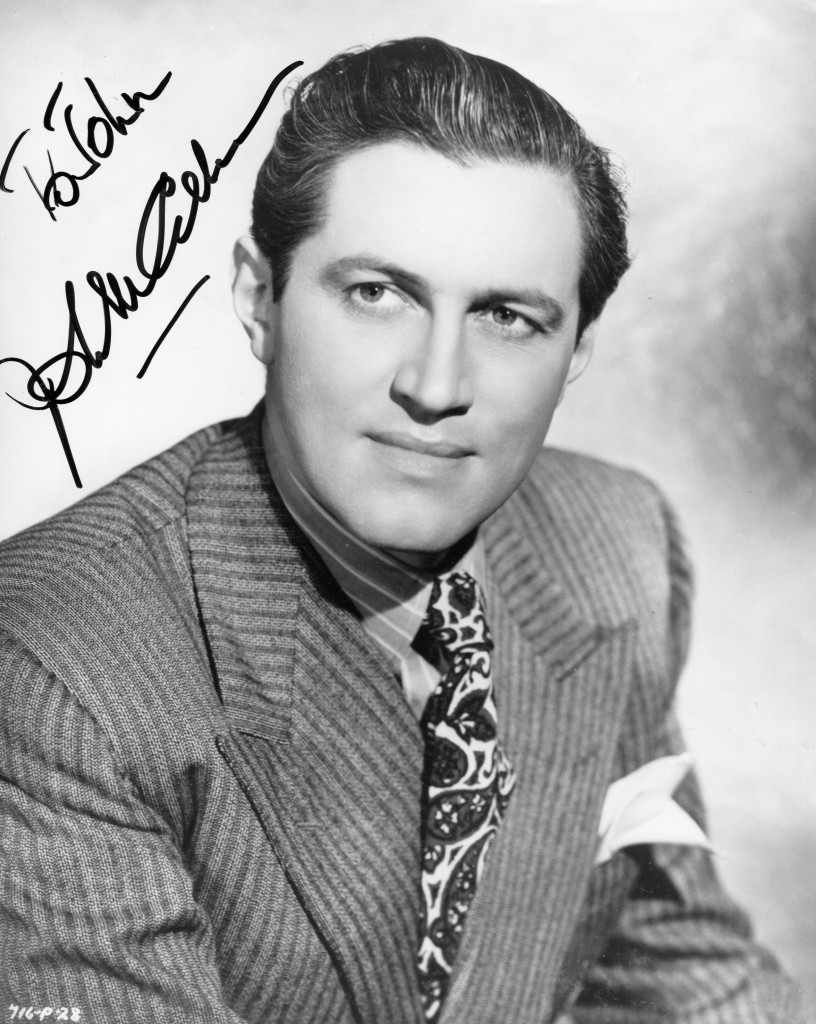
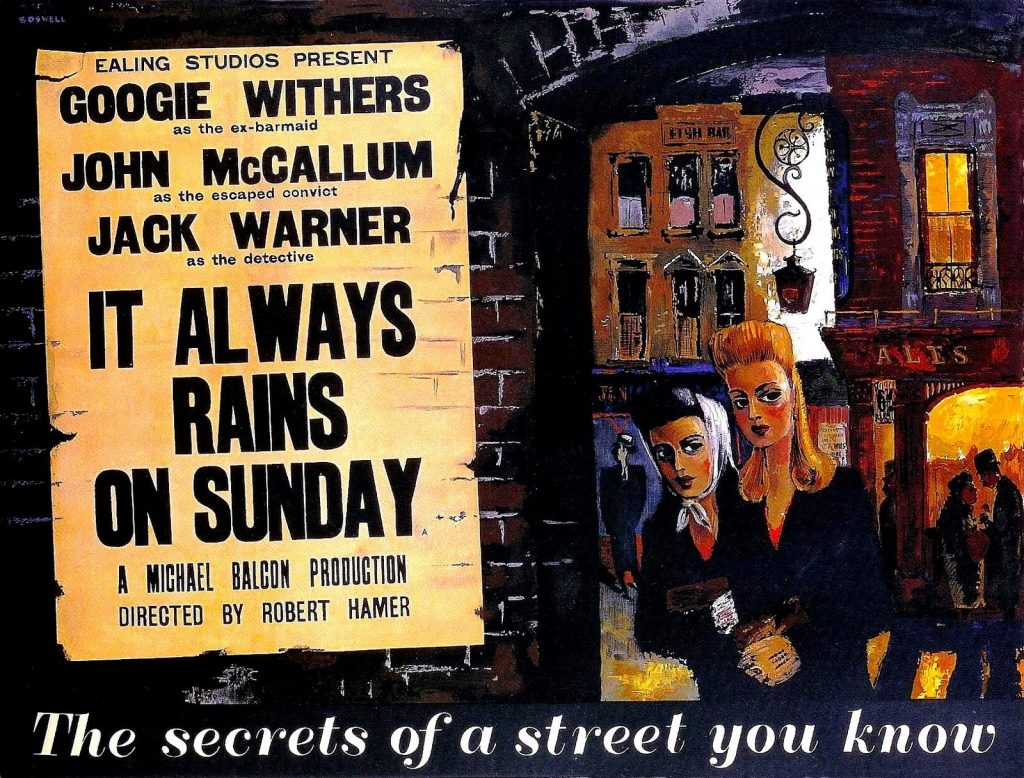
John McCallum was born in 1918 in Brisbane, Australia. He came to London to study at RADA. He returned to Australia at the outbreak of World War Two to serve in the military. He resumed his career on the sage and then came back to England and acted on film. He met his wife Googie Withers while making “It Always Rains on Sundays” in 1947. Other films of note include “The Root of All Evil”, ” The Women in Question”, “Trouble in the Glen” and “Port of Escape”. In 1958 he and Googie Withers settled back in Australia and he became a very successful producer for film, television and theatre. he and his wife continued to act together on stage in the UK, Australia and in New York until they they were well into their eighties. He died in 2010.
His “Guardian” obituary by Dennis Barker:
The ruggedly handsome Australian actor John McCallum, who has died aged 91, enhanced the golden era of postwar British cinema with his extrovert muscularity. He starred in films such as The Loves of Joanna Godden and It Always Rains On Sunday (both 1947), then returned to Australia with his wife and frequent co-star, Googie Withers, to become an impresario in theatre, film and television. His TV hits included the popular series Skippy (1966-68), developed with the producer Lee Robinson, which followed the escapades of a daredevil kangaroo which McCallum had first named Hoppy. More than 90 episodes were filmed, and the series became one of the best known Australian TV exports.
McCallum’s Scottish grandparents emigrated as farmers but edged their son into the role of a church organist in Brisbane. His father moved on to concert management and built the 3,000-seat Cremorne theatre in Brisbane, where he staged his own music and theatre productions. John was born in Brisbane on the opening night of a comedy produced by his father, prompting a friend’s telegram the next day, congratulating the family on “two howling successes”.
His mother, Lillian, from whom he said he inherited the dramatic side of his nature, was footloose between Australia and Britain. John was schooled in Harrogate, North Yorkshire, then returned to Australia, where he studied at Knox grammar school in Sydney and the Church of England grammar school in Brisbane. He made his stage debut, as Cardinal Wolsey in Henry VIII, at the Cremorne in 1934. He was back in England by the late 1930s, studying at Rada, appearing in rep and at the Stratford-on-Avon Festival theatre.
After serving with the Australian Infantry Force in the second world war, he began a dozen fruitful years in British films. He met Withers on the film The Loves of Joanna Godden. (Upon being told the name of her leading man, Withers sent a cable to the production company, demanding: “Who the hell’s John McCallum?”) His most memorable picture was It Always Rains On Sunday, in which he was cast as a murderer on the run who exploits a previous love (Withers), who is now married. Set in the East End of London, the film had a grey grimness unusual in the productions of Ealing studios. McCallum had walked the streets of the East End to get the accent right.
Withers and McCallum married in 1948 and proceeded to star together in several films, including Traveller’s Joy (1949), Derby Day (1952), Devil On Horseback (1954) and Port of Escape (1956). By 1958, a far less quick-witted man could have read the writing on the wall: the British film industry, which had given McCallum and Withers a nice house alongside a golf course at Denham, Buckinghamshire, and the stimulus of working on more than one film at a time, was being killed off by TV. After exploratory tours of Australia with his wife, McCallum moved to Melbourne to run the production arm of the JC Williamson theatre management company.
He enjoyed successes, including My Fair Lady, as well as lean periods at Williamson, then moved into independent production of films, plays and TV series, chiefly for the Australian market. He became chairman and executive producer of Fauna Films in 1967, enjoying success with Skippy, the adventure series Barrier Reef (1970) and the detective show Boney (1971-72). He kept his connection with England by occasional stage appearances, including a role opposite Ingrid Bergman in The Constant Wife at the Albery Theatre in London in 1973-74, and with Withers in The Circle at Chichester Festival Theatre and then the Haymarket in London in 1976. A memoir, Life With Googie, was published in 1979.
The only play he wrote as well as produced, As It’s Played Today (1974), a political satire, folded after only a few weeks at the Comedy Theatre in Melbourne. President of the Australian Film Council in 1971-72, McCallum was appointed CBE in 1971 and made an officer of the Order of Australia in 1992.
He is survived by Withers and their children, Nicholas, Joanna and Amanda.
• John Neil McCallum, actor, born 14 March 1918; died 3 February 2010