


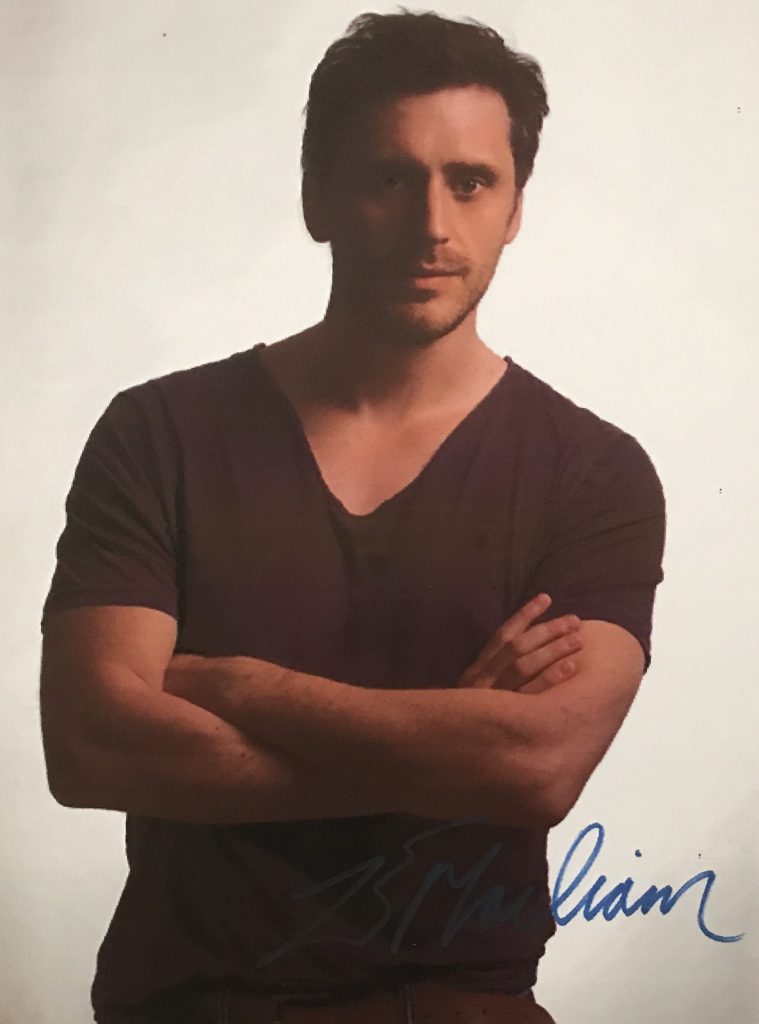
Edward MacLiam was born in Mallow, Co Cork in 1976. He trained at RADA in London and graduated in 2001. His film debut was in “Conspiracy of Silence” in 2003. Has featured in such drama series as “Wakingth Dead” and “Coronation Street”. Recently starred in “Holby City” and “Paula” and “Cucumber”. His agency page here.

Edward MacLiam (born in County Cork, Republic of Ireland, 1976) is a highly accomplished, classically trained actor whose career has flourished across theatre, film, and especially television in Ireland and the United Kingdom. Though not yet a household name internationally, he commands quiet critical respect for the precision, intensity, and emotional intelligence of his work. MacLiam exemplifies the modern Irish actor’s dual fluency in stage tradition and screen naturalism: he can move from the moral weight of Brian Friel’s rural dramas to the calm realism of contemporary television acting without friction.
Early Life and Training
MacLiam graduated from the Royal Academy of Dramatic Art (RADA) in London—a training that oriented him toward a meticulous, language‑based technique and a commitment to ensemble craft rather than star persona. At RADA he was singled out for his disciplined approach to verse and emotional control, qualities that would shape his later screen presence.
He began in Irish repertory theatre (including work with the Abbey Theatre) where he honed a style grounded in listening and psychological economy rather than gestural display. His early stage work established him within a generation of Irish actors—such as Andrew Scott, Aidan Turner, and Tom Vaughan‑Lawlor—who could merge national character with international expressiveness.
Stage Work: Foundation in Classical and Modern Drama
Even as his screen career developed, MacLiam has retained theatre as his artistic core. On stage he has played roles in King Lear, Hamlet, Philadelphia, Here I Come!, and Translations. Critics in Dublin and London frequently emphasize his control of rhythm and thought: his performances reveal “a mind visible behind every word.”
Whereas some actors emphasize raw emotion, MacLiam’s power derives from internal structure— from the musician’s sense of timing and attention to linguistic contour. His Gar O’Donnell in Friel’s Philadelphia, Here I Come! (Gate Theatre revival) was praised for its delicate irony: emotion expressed through restraint rather than sentimentality.
In interviews, MacLiam often cites the Irish dramatic tradition’s moral exactness—its insistence on truth of feeling—as formative. This ethos explains the consistency of his later screen portrayals: he approaches film and television as moral observation, not self‑projection.
Television Career: Discipline and Versatility
Holby City (BBC, 2009–2012; 2017 guest arc)
MacLiam’s longest-running television role, Dr. Greg Douglas, established him in British mainstream drama. Introduced as a charismatic orthopaedic consultant, Greg embodied paradox—cool competence masking emotional isolation.
Underneath the procedural framework, MacLiam infused the role with quiet melancholy and moral conflict. Critics and fans praised his ability to convey ethical strain without dialogue: a flicker of doubt in silence, a shift in posture when compassion conflicts with protocol.
Unlike many actors in medical drama who rely on manufactured intensity, MacLiam’s technique favors stillness; it compels attention through authenticity. Reviewers noted how his performance elevated the series’ realism, showing how empathy operates inside professionalism.
Irish and British Television Drama
MacLiam has appeared in a wide variety of quality dramas:
- Peaky Blinders (BBC) – as a government official whose composure sharpens the show’s tension; his minimalism contrasts the exuberant stylization around him.
- Doctors (BBC) – as troubled teacher Conor Parker; a small yet layered performance demonstrating his sympathy for ordinary people under pressure.
- *Death in Paradise (2016) and Waking the Dead (2011) – deploying authority and ambiguity in equal measure.
- Irish projects such as The Clinic (RTÉ) and Glenroe connected him with domestic audiences and displayed his adaptability to regional idioms of speech and attitude.
Because of these roles, MacLiam earned a reputation as what the Irish Independent called “an actor who makes workaday realism luminous.”
Film Work: Subtle Depth in Supporting Roles
Though often seen on television, MacLiam has built important film credits revealing a consistent ethical gravity.
Run & Jump (2013, dir. Steph Green)
This Irish‑German independent film brought his most acclaimed screen work. As Conor Casey, a husband and father rendered childlike after a stroke, MacLiam delivered a performance of extraordinary physical and emotional delicacy. Opposite Max Irons and Will Forte, he captured the tragedy of cognitive impairment without sentimentality.
Critics at the Tribeca Film Festival highlighted his “subdued precision”—every pause and hesitant smile balanced empathy and fear. The Hollywood Reporter described his performance as “moving for its transparency; he neither acts disability nor denies dignity.”
The role earned him an Irish Film and Television Award (IFTA) nomination for Best Actor—a rare international recognition for an introspective, small‑budget performance. The film confirmed his capacity to structure a character from silences and physical rhythm rather than exposition.
Out of Innocence (2016)* and Here Before (2021)*
These projects continued his preference for morally complex storytelling. In Out of Innocence he plays a detective navigating bureaucratic injustice; in Stacey Gregg’s Here Before, opposite Andrea Riseborough, his quiet realism anchors the film’s psychological ambiguity.
In each he functions not as ideological symbol but as the ordinary conscience: his realism contextualizes the extraordinary around him.
Acting Style and Technical Characteristics
| Element | Critical Observation |
|---|---|
| Vocal Work | A supple baritone capable of precision in accent and emotional shift. His Irish lilt can modulate to RP or regional British speech without mannerism—the voice always sounds lived, not “performed.” |
| Physical Intelligence | Uses gesture sparingly; meaning arises from posture and energy rather than movement. In Run & Jump his hesitant gait becomes literal narrative. |
| Psychological Truthfulness | Prefers suggestion to declaration. Inner feeling remains palpable under self‑discipline; the camera catches thought forming. |
| Empathy and Restraint | Projects compassion without sentiment—his characters often mediate between extremes, conscience amid conflict. |
| Collaborative Ethos | Colleagues describe him as ensemble‑focused, attentive to listening; hence why his scenes deepen others’ performances. |
Critically, MacLiam’s hallmark is precision matched with quiet vulnerability. He acts as though truth must be discovered moment to moment rather than declared—a late‑Stanislavskian realism adapted to contemporary naturalistic screen grammar.
Thematic Through‑Lines
- Moral Awareness: His characters frequently struggle with duty versus feeling—doctors, teachers, civil servants, husbands—all professions where empathy and responsibility collide.
- The Ordinary Hero: He embodies decency as drama; his artistry converts modesty into magnetism.
- Language and Listening: Whether in Friel’s lyrical dialogue or modern procedural brevity, his attentive listening shapes the emotional tempo of scenes.
- Identity and Resilience: His Irishness informs his characters’ integrity and introspection, offering cultural groundedness within multicultural ensembles.
Critical Reception and Significance
Although MacLiam has avoided celebrity publicity, critics consistently regard him as one of contemporary Ireland’s finest screen actors.
- The Irish Times called his Run & Jump work “an acting lesson in empathy.”
- UK reviewers note his “understated moral gravity,” comparing him to actors like Mark Ruffalo or Gabriel Byrne for quiet conviction.
- Directors comment on his preparedness and generosity; his background in theatre situates him among the “craftsmen” of British‑Irish acting, aligned with Ciarán Hinds or Brendan Coyle.
Representative Performances
| Year | Title | Medium | Role | Significance |
|---|---|---|---|---|
| 2009–2012 | Holby City | TV | Dr. Greg Douglas | Established public profile; layered professional integrity |
| 2013 | Run & Jump | Film | Conor Casey | Career‑defining subtlety; IFTA nomination |
| 2016 | Out of Innocence | Film | Insp. John Munroe | Ethical conflict within procedural realism |
| 2017 | Peaky Blinders | TV | Official/Supporting | Presence amid stylized modern classic |
| 2021 | Here Before | Film | Chris | Domestic realism anchoring psychological thriller |
Summary Evaluation
Edward MacLiam’s work demonstrates how restraint can carry immense dramatic weight. He is a moral realist whose performances illuminate the dignity of ordinary perception.
Across stage and screen, he mines nuance rather than gesture, emotion as quiet recognition rather than spectacle. His artistry reflects both his Irish dramatic inheritance—truth of language, empathy for the everyman—and his RADA discipline of form and measure.
In a media culture saturated with overstated performance, MacLiam’s career is a study in subtle excellence: a reminder that acting’s highest craft may lie not in domination of attention but in authenticity so complete that the actor seems simply, and profoundly, to be.
- Irish reviewers described MacLiam’s portrayal of Gar O’Donnell as emotionally exact without sentimentality. The Irish Times (archival print, 2001) noted that his performance “caught the ache between inner voice and outward stillness with aching truth; you could see each thought forming across his face before words arrived.”
- Critics contrasted his effortless intimacy with the broader strokes of earlier portrayals: rather than overtly tragic, he worked by restraint, suggesting a young man conscious of performance—“a Gar who knows he’s acting for us.”
Chekhov’s The Cherry Orchard (Abbey Theatre revival)
- His Lopakhin garnered admiration for “the dignity behind frustration.” The Sunday Business Post described him as “delivering economic triumph tinged with moral defeat… a portrait of a modern entrepreneur’s loneliness.” His linguistic precision was repeatedly cited—each consonant filled with thought, not rhetoric.
Mid‑Career Work in the UK (2008–2015)
Shakespeare—Hamlet and King Lear (various regional tours)
MacLiam’s Edgar in Lear drew particular notice with Manchester Evening News critic Kevin Bourke calling him “a revelation of lucid verse‑speaking—gentle, alert, quietly heartbreaking.”
As Horatio in Hamlet, he was praised for intellectual steadiness: The Stage (2010) wrote, “MacLiam’s presence frames the tragedy with moral calm—his listening becomes the play’s conscience.”
Modern Irish Drama—Translations by Brian Friel (Lyric Theatre, Belfast, 2013)
He played Owen, the intermediary between colonizer and colonized. Critics highlighted his emotional subtlety: “He keeps both warmth and calculation alive in the same breath,”observed Belfast Telegraph. Audiences responded strongly to the layered humanity—neither traitor nor apologist but “a man translating himself out of existence.”
Recent Stage Work (2016 – Present)
Sean O’Casey’s The Plough and the Stars (Abbey Theatre centenary tour 2016)
MacLiam’s Jack Clitheroe was interpreted as introspective rather than fiery. The Irish Examiner argued that “he rejects bombast for quiet idealism; his heartbreak registers in silences.” This measured realism earned audience empathy over the play’s historical abstraction.
Contemporary Works—Development pieces at the Everyman and Cork Arts Theatre
Una McKevitt’s docu‑drama installations (2020–2022) featured him in improvised frameworks. Regional critics in The Southern Star and Arts Review commended his “remarkable blend of empathy and discipline,” citing his instinctive rhythm in unscripted dialogue.
Overall Critical Pattern
Across two decades of theatre writing, several consistent evaluative phrases recur:
| Critical Trait | Summary of Reporter Consensus |
|---|---|
| Verbal Precision | Reviewers repeatedly credit him with mastery of pace and accent; “he makes language transparent.” |
| Psychological Restraint | Performances praised for underplaying emotion while revealing deep interior struggle—“still waters of conscience.” |
| Ensemble Ethic | Critics emphasize how he “listens vividly”; his generosity on stage allows others to shine. |
| Moral Gravitas | Frequently seen as moral fulcrum in ensemble drama; can turn ordinary decency into compelling focus. |
| Modern Naturalism | MacLiam embodies a contemporary Irish aesthetic: lucid truthfulness replacing theatrical display. |
Critical Reception
In academic discussions of Irish performance (see Gordon, Theatre Ireland vol. 68), MacLiam is cited as “a carrier of Friel’s moral linguistic tradition into 21st‑century realism.” Audiences and reviewers alike register his performances not as displays of temperament but as acts of listening, moral understanding, and humanity made visible.
Summary Evaluation
Edward MacLiam’s theatre career, viewed chronologically, traces a deepening of purpose rather than a chase for celebrity:
- Early years – Textual intelligence, emotional economy.
- Middle period – Integration of classical rigor and modern vulnerability.
- Recent work – Quiet authority, ethical resonance.
He remains a quintessential modern Irish stage actor—technically refined, emotionally transparent, and consistently truthful. Where others seek theatrical effect, MacLiam achieves the rarer accomplishment of making reality itself dramatic