

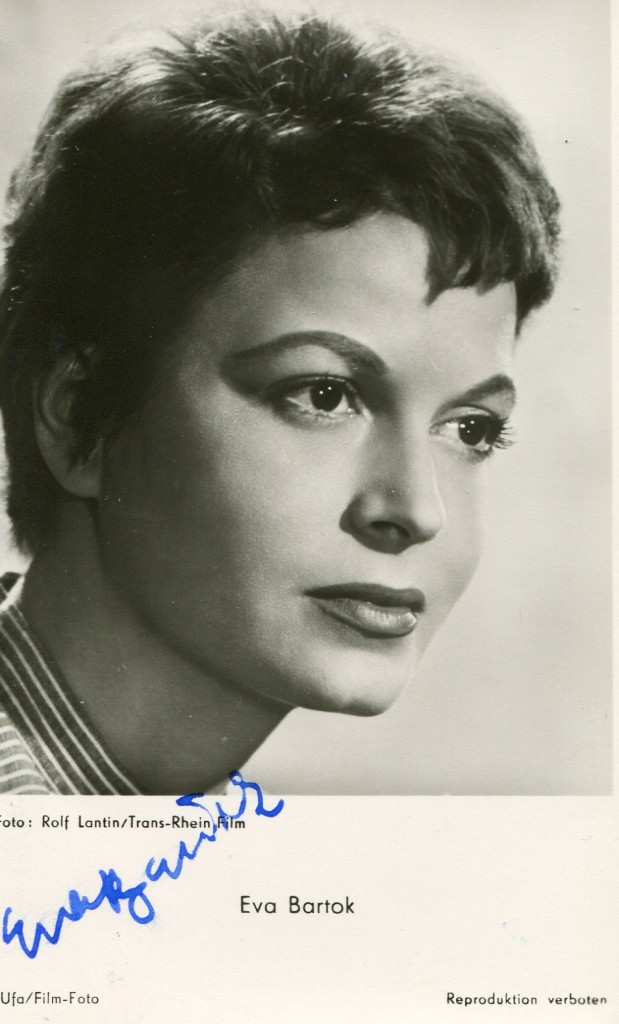
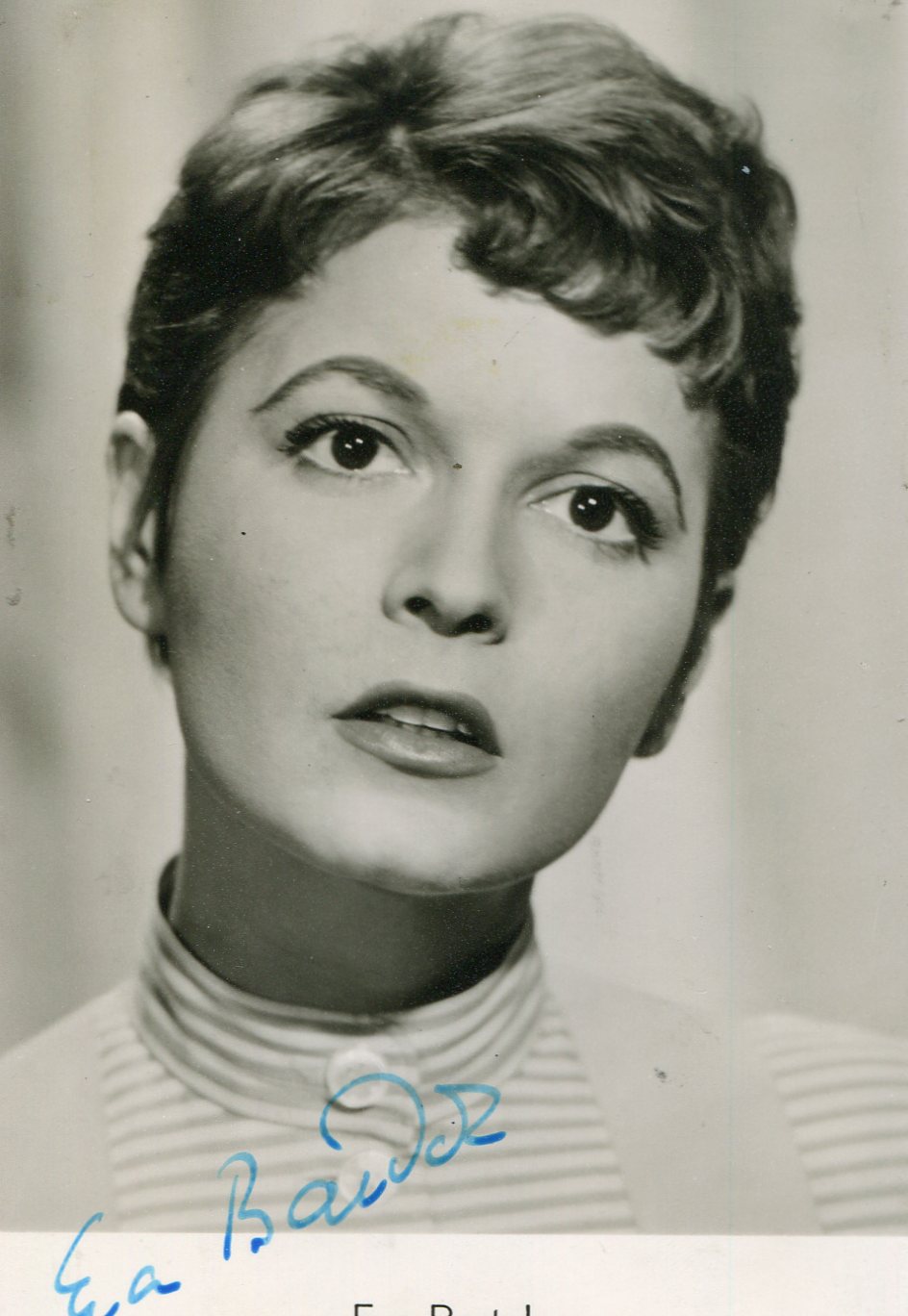
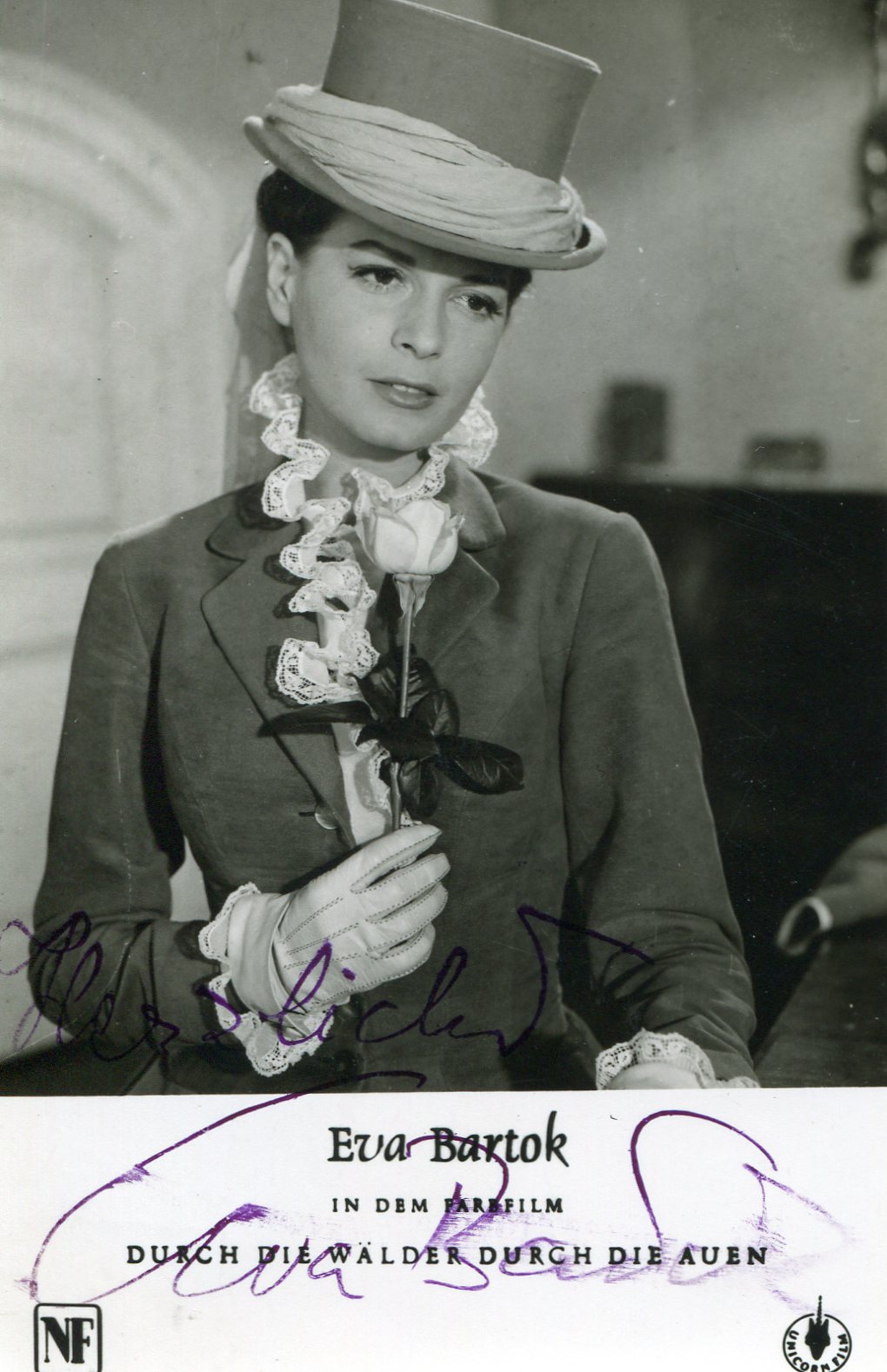
The independent obituary in 1998.
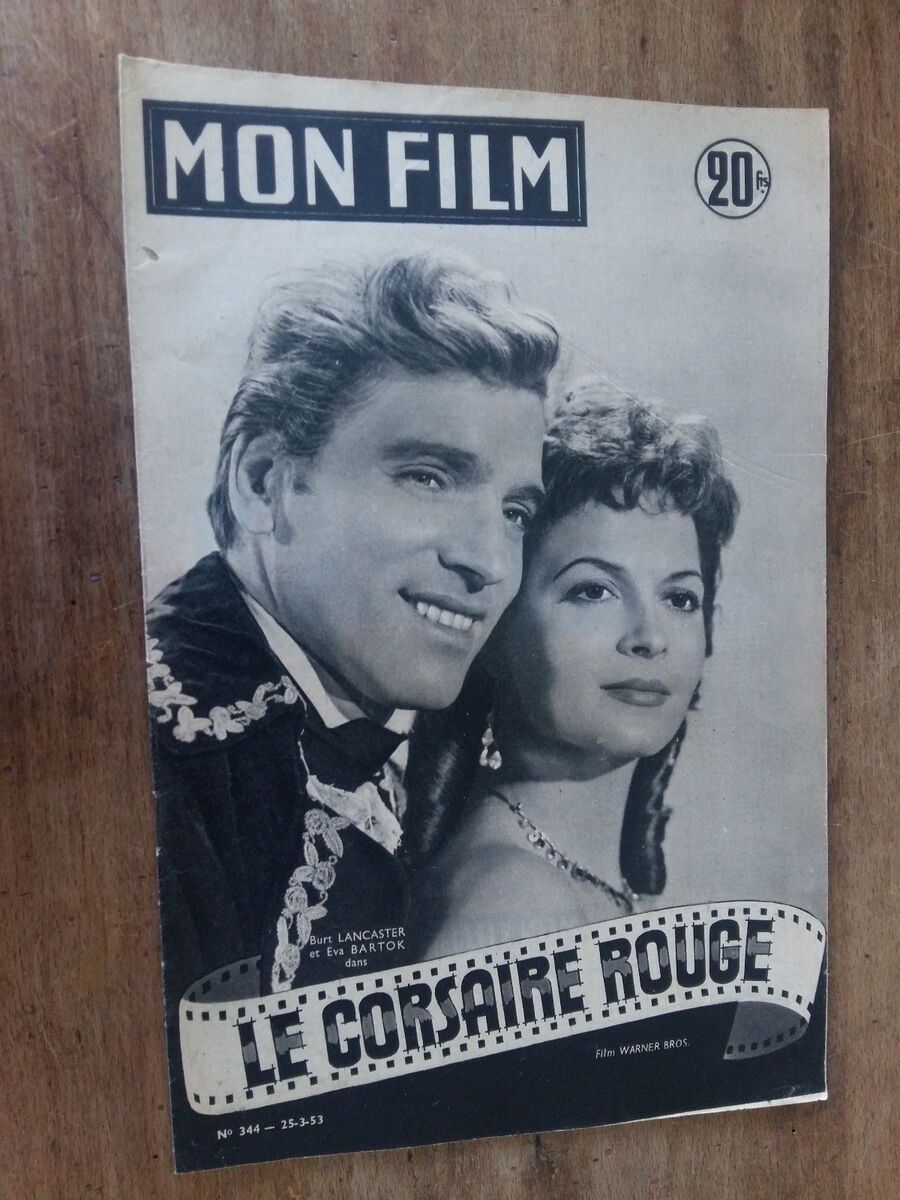
ALTHOUGH PUBLICISED in the Fifties as Britain’s answer to Sophia Loren, the actress Eva Bartok became better known for her tempestuous private life than for her appearances in a string of generally mediocre films. By the time she was 30, she had been married and divorced four times, one of her husbands being actor Curt Jurgens, while her lovers included the Marquess of Milford Haven and Frank Sinatra. Her most notable films are two cult movies, the pastiche swashbuckler The Crimson Pirate, in which she starred opposite Burt Lancaster, and Mario Bava’s horror film Blood and Black Lace.
Born Eva Martha Szoke in Keoskemet, Hungary, in 1926, she married her first husband, Giza Kovas, a Nazi, while only 15 years old and after imprisonment in a concentration camp. The marriage was later annulled on the grounds of coercion of a minor.
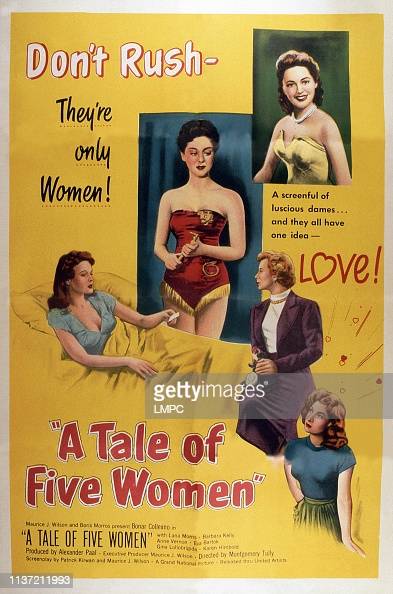
A strikingly beautiful brunette, she found work on the Budapest stage after the Second World War, and made her film debut in a Hungarian film, Mezet Profeta (released in the United States as Prophet of the Field), in 1947. When she wrote to an old friend, the film producer Alexander Paal, begging him to help her escape from Soviet-dominated Budapest, Paal arranged a “passport marriage”, took her to London and gave her the leading role in his film A Tale of Five Cities (1951) in which an airman (Bonar Colleano) who has lost his memory traces his past by means of five bank- notes he has in his possession, each with the signature of a girl.
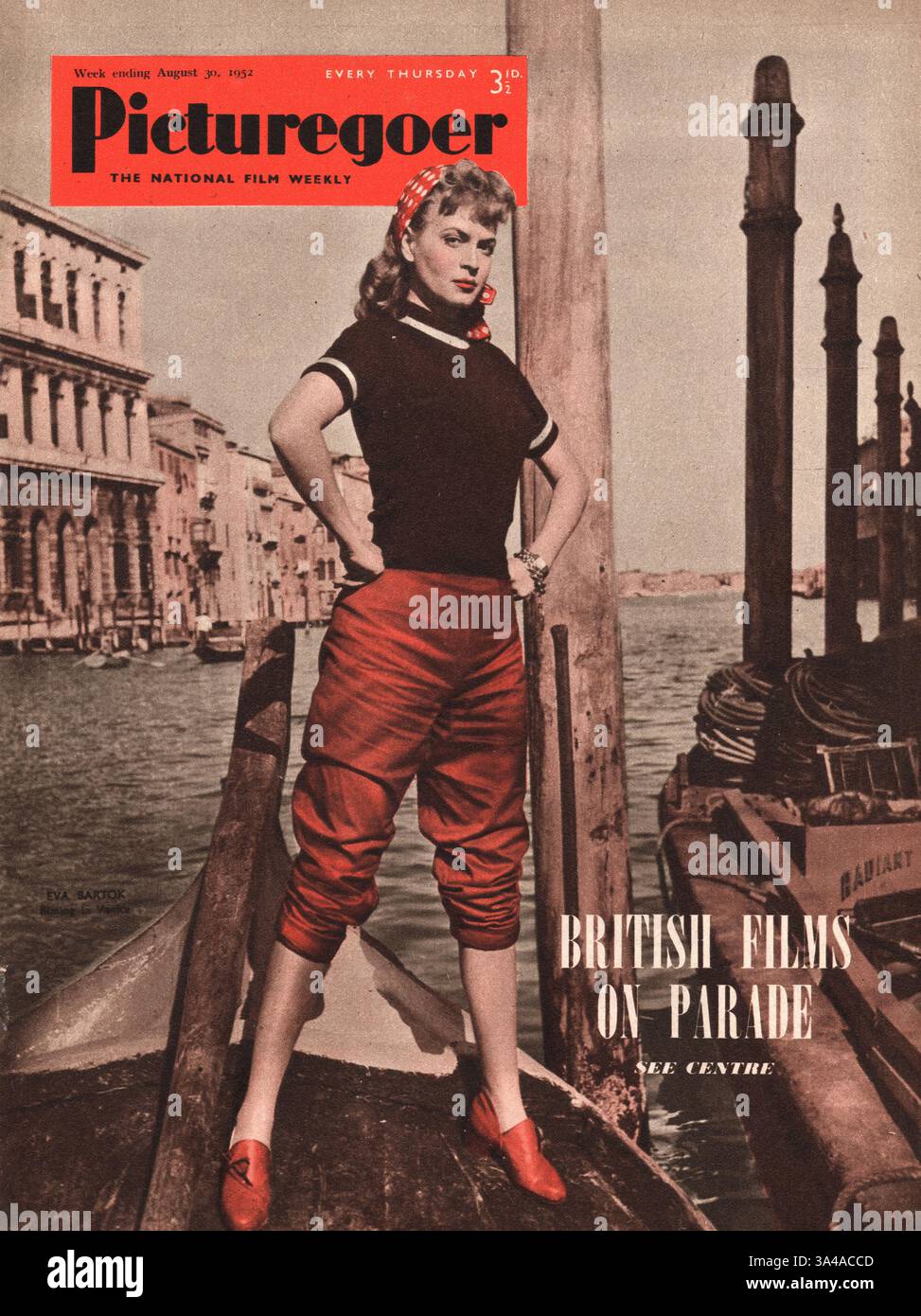
After its release, Bartok divorced Paal and in 1951 married the publicist William Wordsworth. The international flavour of her career was quickly established – her next roles took her to Italy (Venetian Bird, 1952) and to both the Bay of Naples and the island of Ischia for one of her best remembered films, The Crimson Pirate (1952).
Though plagued with difficulties during shooting (at one point the star Burt Lancaster called its director Robert Siodmak “a silly old has-been”) and rumoured to have been started as a straightforward action tale then switched midstream to farce, the film proved enormously popular. Bartok played Consuelo, the daughter of a revolutionary on a Caribbean island who persuades the pirate Lancaster to swap sides and, instead of helping a Spanish tyrant quash her father’s rebellion, lead his ramshackle bunch of swashbucklers to achieve the island’s independence.
But Bartok’s career failed to move into the major league. Her next roles were in B movies, as a mathematician who stows away in a space rocket with the scientist she loves in Spaceways (1953) and a duplicitous diamond smuggler in Park Palza 605 (1953). She made several films in Germany, including three with her fourth husband, Curt Jurgens, Der Letze Walzer (1953), Rummelplatz der Leibe (Circus of Love, 1954) and Orient Express (1954), but it was her provocative personal life that made her name familiar to the public, notably her stormy marriage to Jurgens and a highly publicised five-year affair with the then Marquess of Milford Haven, who had been best man at the wedding of Princess Elizabeth and Prince Philip; Bartok was named in his wife’s divorce action.
In 1956 Bartok went to Hollywood to appear in the musical Ten Thousand Bedrooms, in which Dean Martin (in his first film without his partner Jerry Lewis) played the owner of a string of luxury hotels. The marriage of Martin’s friend Frank Sinatra to Ava Gardner was just breaking up (they divorced in 1957) and Sinatra and Bartok embarked on an affair. In 1957 Bartok’s daughter Deana was born, with both Milford Haven and Jurgens purporting to be the father. Jurgens’ name was on the birth certificate, but some years later he confessed that he was infertile, and last year Bartok claimed that Sinatra was Deana’s father.
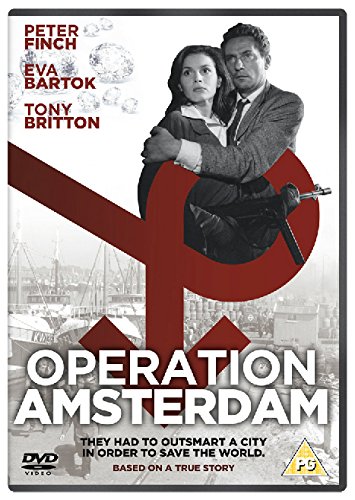
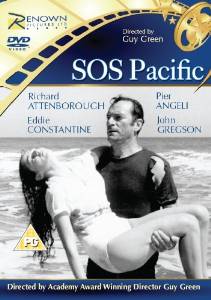
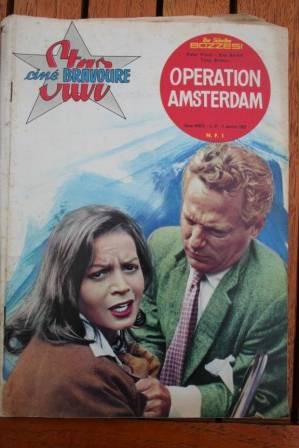
Bartok’s film career continued to take her around the world – British films included Operation Amsterdam (1959), as a member of the Dutch resistance in 1940, and a fanciful adventure tale of a bunch of plane-crash survivors who find they have landed at the site of an H-bomb test, S.O.S. Pacific, recently described by its director Guy Green as “pretty indifferent”. In 1963 she made a gruesome horror film in Italy, Sei donne per l’assassino (Blood and Black Lace), about a string of fashion model murders, which has gained a reputation due to Mario Bava’s atmospheric directing and striking use of colour.
Milford Haven had introduced Bartok to the teachings of the Indonesian guru Pak Subuh, and in 1968 Bartok gave up her career and took her daughter to live a life of “peace and tranquillity” in Jakarta, Indonesia. She then moved to Honolulu, where she opened a school to teach the Subuh philosophy.
Bartok returned to acting in 1974 when she appeared with the soccer star Pele in Pele, King of Football, but it failed to promote further film offers. Recently Eva Bartok, described by her former agent as “at one time one of the most photographed women around and one of the most beautiful women in the world”, had been living in a hotel in Paddington
Tom Vallance
Eva Martha Szoke (Eva Bartok), actress: born Keoskemet, Hungary 18 June 1926; married first Giza Kovas (marriage dissolved), second Alexander Paal (marriage dissolved), third William Wordsworth (marriage dissolved), fourth Curt Jurgens (one daughter; marriage dissolved); died London 1 August 1998


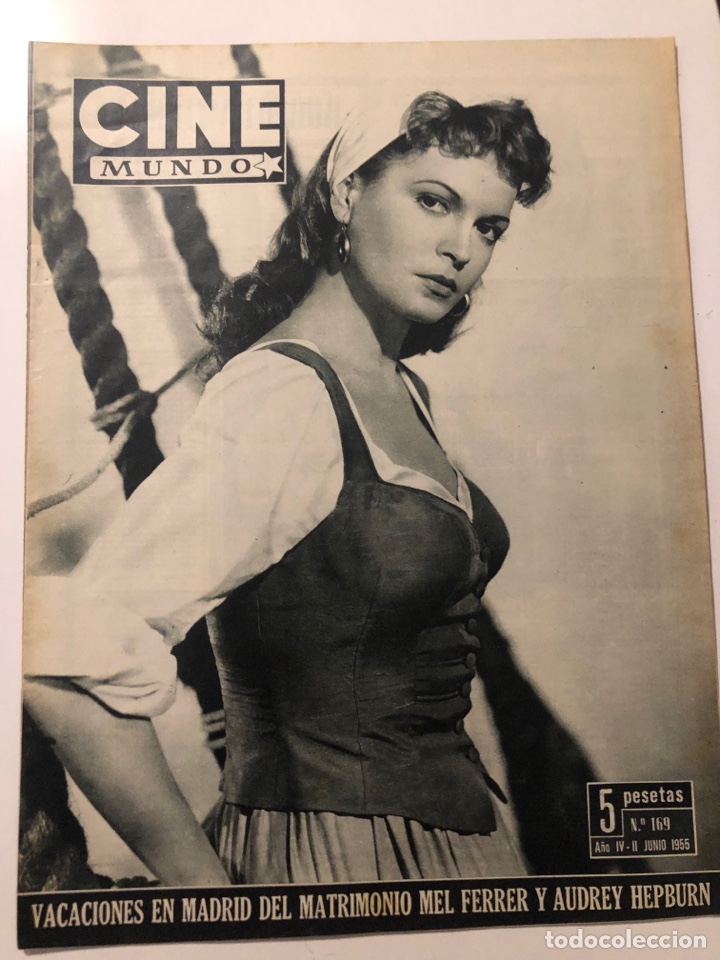
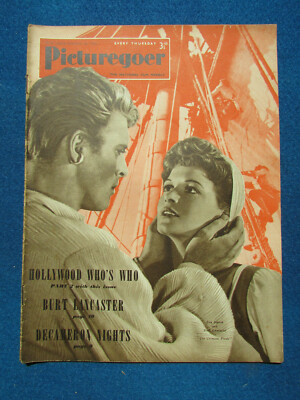
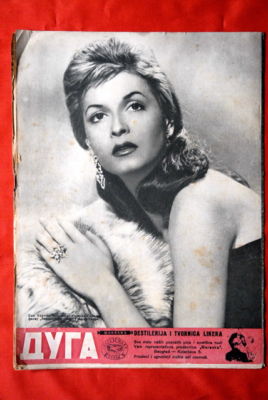

Eva Bartok (1927–1998) was a Hungarian-born actress whose career—spanning postwar European cinema and 1950s British and American productions—illustrates both the cosmopolitan nature of mid-century film culture and the particular complexities faced by continental actresses working across languages, genres, and national identities. Best remembered today for her work in historical adventure films and cult European thrillers, Bartok’s career combined elegance with emotional opacity, eroticism with self-possession—a blend that made her a symbol of dislocated postwar femininity on screen.
Early Life and Formation (1927–1948)
Born Éva Marton in Budapest, Bartok’s adolescence was marked by trauma. Forced into an arranged marriage at sixteen to a Nazi officer to avoid deportation during the Second World War, she later annulled the union. This early experience of coercion and resilience profoundly shaped her artistic persona. Her later performances carried an unmistakable sense of inner turbulence restrained by dignity—a personal history that lent psychological reality to her often exoticized screen characters.
After the war, Bartok trained in Budapest’s theatre scene and fled Communist Hungary for Western Europe, joining displaced artists who would reshape European cinema after 1945. Her multilingual ability and striking beauty soon led to film work in Britain and Germany.
British Career and Midcentury Stardom (1949–1955)
Bartok’s British entry coincided with a growing audience appetite for continental sophistication. She first appeared in minor roles but quickly established herself as both alluring and refined—an actress who combined Old World glamour with modern detachment.
The Crimson Pirate (1952)
Bartok’s breakthrough came opposite Burt Lancaster in this Technicolor swashbuckler directed by Robert Siodmak. As Consuelo, she projected an intelligence uncommon in the genre’s stereotypical heroines. Film historians note how Bartok’s European poise counterbalanced Lancaster’s athletic exuberance—embodying the postwar fascination with cosmopolitan adventure. Her controlled gesture and quiet authority added psychological depth to a stylistically exuberant spectacle.
Operation Amsterdam (1959)* (note: British production albeit slightly later)
Bartok’s performance in this wartime thriller typified her ability to suggest emotional duality—loyalty tempered by personal pain—within a tight, pragmatic narrative frame.
During this decade, she also appeared in popular British films such as Venetian Bird (1952, dir. Ralph Thomas) and A Hill in Korea (1956), where her cool magnetism contrasted sharply with the earthy realism of postwar British acting. This tension—between European sophistication and Anglo-American naturalism—often defined her screen persona.
European Cinematic Expansion (1955–1960)
With linguistic fluency and cosmopolitan appeal, Bartok became a sought-after actress in continental productions, working with major European directors who explored stylistic modernism and moral ambivalence.
Il prezzo della gloria (1955)* and The Counterfeit Plan (1957)*
In these genre pieces, she alternated between femme fatale and moral conscience. Her performances carried a particular emotional decorum: even when playing seductive or duplicitous women, she never lost an undercurrent of sadness or reflective intelligence.
The Blue Lamp (1950s television and film appearances, mixed minor roles)*
Though much of her British work remained within pulp or genre constraints, critics noted a consistent aesthetic presence—what one reviewer called “emotional containment wrapped in sensual luminosity.”
Peak and Cult Status: Blood and Black Lace (1964)
Despite a gradual decline in high-profile roles, Bartok achieved posthumous cult renown through her collaboration with Italian horror maestro Mario Bava on Sei donne per l’assassino (Blood and Black Lace) (1964). As Contessa Christina Como, the owner of a fashion house plagued by murders, Bartok embodied the cool, immaculate morbidity that would define the European giallo.
Bava’s stylized use of color and composition—filters, mirrors, mannequins—made Bartok’s beauty both seductive and uncanny. Her acting here becomes almost sculptural: a performance rooted not in dialogue but in stillness, gaze, and ritualized gesture. Film scholars regard Blood and Black Lace as a turning point for the giallo where the actress’s body becomes part of the film’s visual design. Bartok’s performance, simultaneously luxurious and spectral, anticipates later art-horror heroines by Catherine Deneuve (Repulsion) and Helga Liné.
Critically, this role recontextualized Bartok’s earlier European glamour: the poised survivor of adventure and war cinema transformed into an emblem of modernist anxiety. It remains her most critically reassessed work.
Acting Style and Critical Characteristics
Controlled Elegance and Emotional Displacement
Bartok’s acting drew on subtle modulation rather than expressivity. She seldom resorted to overt realism; her performances relied on gestural economy and vocal precision. This restraint, shaped perhaps by her multilingual performances and transnational career, gave her characters a sense of alienation—modern women adrift between passion and propriety.
Thematic Recurrent Traits
Across her diverse roles, certain motifs recur:
- Exile and Displacement: As a real émigré, she often played outsiders—aristocrats, refugees, countesses, or foreigners caught in intrigue.
- Sexual Autonomy vs. Control: Bartok’s heroines frequently struggle between sensual freedom and imposed decorum, mirroring postwar shifts in female representation.
- Ambivalence and Mystery: Directors exploited her ability to suggest conflicting motives; she rarely played moral absolutes.
Technical Signature
- Physical Stillness: She used posture and gaze rather than melodramatic gesture.
- Voice: Her accent—soft Central European inflections—became part of her onscreen identity, evoking sophistication tinged with melancholy.
- Camera Relationship: Bartok possessed an instinct for cinematic composition; she understood how to let light and framing articulate psychological nuance.
Later Career and Withdrawal (1965–1980)
By the late 1960s, Bartok’s screen appearances diminished as European cinema itself underwent cultural change. The rise of youthful, vernacular realism left little room for her Old World polish. She made infrequent television appearances but gradually retired from acting, living quietly in London.
Her offscreen life remained the source of tabloid curiosity—five marriages (including to actor Curd Jürgens), and a self-revelation that her daughter Deanna’s father was actually Frank Sinatra. Nonetheless, her artistic identity always transcended gossip: she preserved dignity even when the press sought scandal.
Critical Reappraisal and Legacy
For much of the late 20th century, Bartok was overshadowed by contemporaries such as Gina Lollobrigida, Martine Carol, or Eva Gabor—figures who embodied either populist sensuality or Americanized exoticism. Yet in retrospect, Bartok’s work stands out for its fusion of European modernity and genre form.
Film scholars and retrospectives have come to view her performances as transitional—between the moral elegance of prewar European acting and the stylized abstraction of 1960s international cinema. Blood and Black Lace now secures her place in film history, its visual grammar making her both muse and symbol of mid-century erotic anxiety.
Critically, her enduring value lies less in the quantity of output than in the tension she embodied: between poise and pain, beauty and skepticism, spectacle and intelligence. She was an actress perfectly suited for the war-haunted, image-conscious Europe of her time.
Summary
Eva Bartok’s career traces a transnational arc—from wartime survival in Hungary to Technicolor adventure in Hollywood, from British thrillers to Italian modernist horror. Her artistry lay in understatement: she communicated moral weariness and emotional depth through composure rather than overt action. Though never a major star in the commercial sense, Bartok occupies a unique niche in film history as a cosmopolitan feminine presence in mid-century cinema, a transitional figure linking classic glamour to psychological modernism. Her performances, especially in The Crimson Pirate and Blood and Black Lace, remain potent studies in beauty confronting both danger and disillusionment