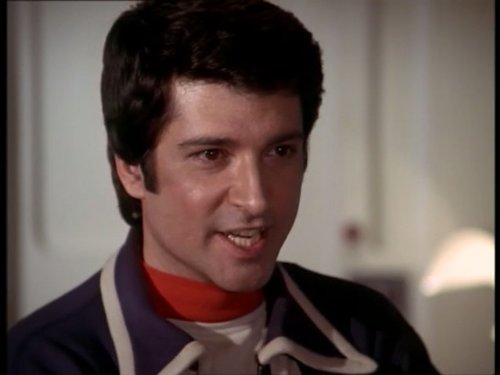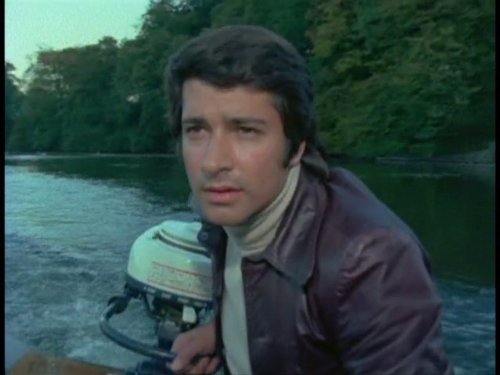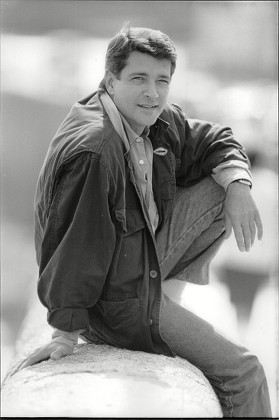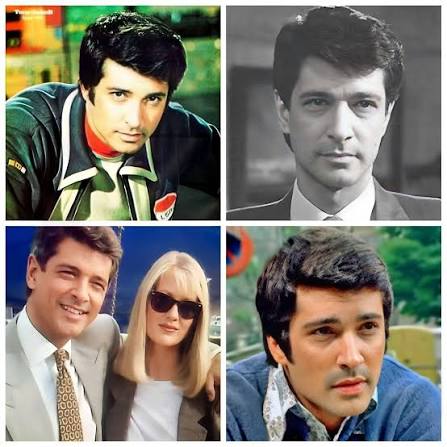

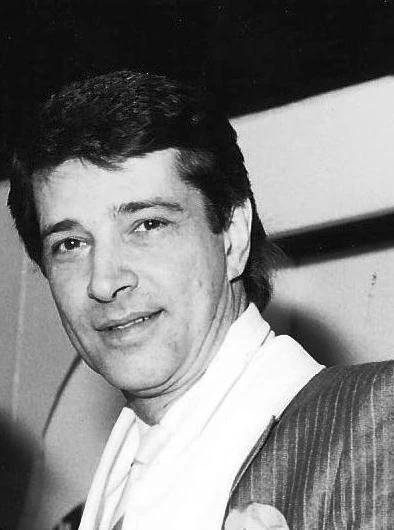
Tony Anholt was born in 1941 in Singapore. During his childhood he also lived in South Africa and Australia before settling in Britain. His television appearances include “Space 1999”, “Howard’s Way” and “Only Fools and Horses”. He starred in the series “The Protectors” with Robert Vaughn and Nyree Dawn Porter. His films include “Fear Is the Key” in 1973. Tony Anholt died in 2002.
Dennis Barker’s obituary of Tony Anholt in “The Guardian”:
Dark-haired, bedroom-eyed, with an engaging smile and what used to be called matinee-idol good looks, the actor Tony Anholt, who has died aged 61 after a period of illness caused by a brain tumour, had a flair for light comedy which tended to obscure a more serious side. He was a voracious reader of books on philosophy and a practical advocate of meditation: when news of his illness first emerged, thousands of fellow meditators included him in their thoughts.
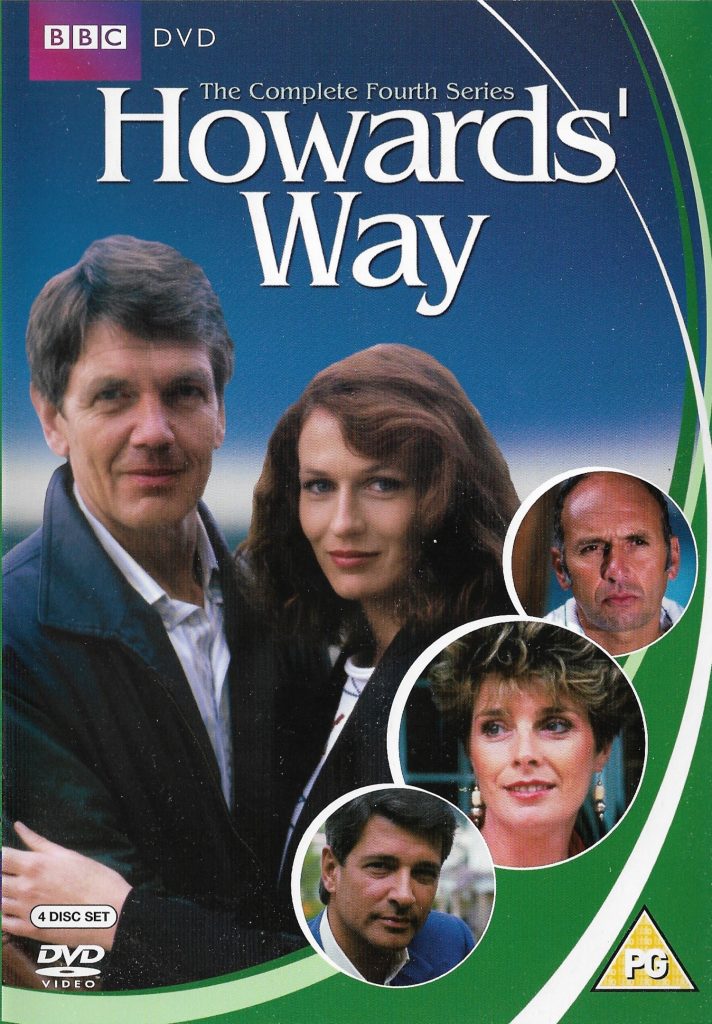
He will be most widely remembered as Charles Frere, the personable and wealthy heartbreaker son of a wealthy father, Sir Edward Frere, played by Nigel Davenport, in the television series Howard’s Way, which ran for five years from 1985. Set around the river Hamble, it dealt with an aircraft designer who had become a boat builder, and whose daughter had an on-off-on affair with the character played by Anholt. The daughter was played by Tracey Childs, who became Anholt’s real-life second wife after an affair that began while the series was still running.
Howard’s Way became compulsive viewing because of interest in Frere’s way with the ladies, as well as a more general interest in the social terrain – fast boats, millionaires, big houses, resplendent cars and good living. Anholt was ideally cast, and undoubtedly the series established his reputation among a broader public; but he played varying roles in many other British television series as well as in the American mini series The Last Days Of Pompeii, with a cast including Ernest Borgnine.
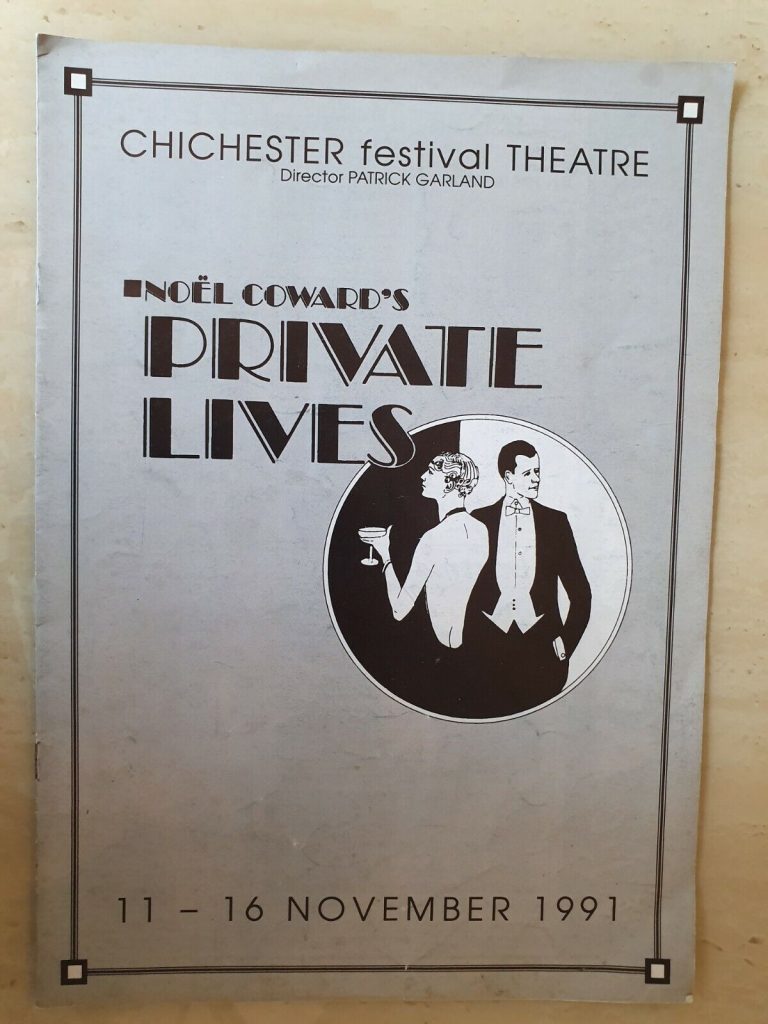
To Anholt’s agents Roger and Primi Carey, he was an actor who died before he could reach the full limits of his potential as a performer on the lines of Cary Grant – one who could switch brilliantly from light to shade. When he played in Anthony Shaffer’s duel of wits, Sleuth, on the West End stage (1978), with Patrick Cargill as the older villain, this sly way with light and shade was tested to the full – as it was in the more heavyweight Amadeus at the Theatre Royal, Windsor, in which he played a darkly sardonic Salieri. Other theatre roles included parts in Edward Albee’s Who’s Afraid Of Virginia Woolf?, The Tempest, Harold Pinter’s Betrayal and Brian Clark’s Whose Life Is It Anyway? In all these, he radiated darkness as well as the ladies’ man stock-in-trade. The Boys In The Band (his first West End appearance, 1969) and Death And The Maiden (1992), both plays he toured nationally, also had a dark side.
Tony Anholt was born in Singapore of an Anglo-Dutch family, and from his schooldays was a pillar of dramatic societies. As a child during the war he was evacuated to Australia, went from there to South Africa and then to Britain. His father had been taken prisoner by the Japanese, was forced to work on the Burma railway and died when his son was three. His mother remarried five years later.
Anholt met his first wife Sheila when he was teaching Latin in a Surrey prep school and she was teaching infants. They went to Spain, first to teach and then to work as holiday resort representatives, later teaching in Paris before returning to Britain. They married in 1964 when he was working on a trade periodical and she was in advertising.
Anholt trained in mask, mime, movement, drama and voice at the Royal Court Theatre, London, and then went into repertory at the Leas Pavilion in Folkestone, where he was in 26 plays in 27 weeks.
In the 1960s and 1970s he made his transformation from theatre idol to a wider range of parts on television. Series he appeared in included Only Fools And Horses, Juliet Bravo, Minder, Citizen Smith, Space 1999, The Sweeney, The Protectors and Kate. His films included The Late Nancy Irving for Hammer Films (1984) and Fear Is The Key (1972). He also worked extensively as a continuity announcer for BBC World Service.
Tony Anholt’s first marriage to his wife Sheila, by whom he had a son, the actor Christien Anholt, ended in divorce in 1986. He and Tracey Childs married in 1990, but divorced eight years later. His relations with both wives remained good: both were at his bedside when he died.
· Anthony Anholt, actor, born January 19 1941; died July 26 2002
The above “Guardian” obituary can also be accessed online here.




.
Tony Anholt was a British stage and screen actor best known for his extensive work in television drama and adventure series from the 1970s through the 1990s. While not typically associated with leading film stardom or major theatrical acclaim, he built a long and steady career as a reliable, versatile television performer, often cast in roles requiring intelligence, authority, or cosmopolitan sophistication.
He represents a particular type of British actor whose career flourished during the expansion of international television co-productions and genre series.
Early Life and Training
Anholt was born in Singapore in 1941 to British parents and educated in the UK. He trained as an actor before entering repertory theatre, a common route for British performers of his generation.
His early professional development included work in theatre repertory companies, where he gained experience in:
- classical and contemporary stage roles
- ensemble performance discipline
- rapid adaptation to varied characters
This training shaped his later screen persona: articulate, controlled, and adaptable across genres.
Theatre and Early Screen Work
Anholt began his career in theatre before moving into television during the 1960s, a period when British TV drama was rapidly expanding.
He appeared in guest roles across anthology series and drama productions typical of the era, including crime, legal, and espionage narratives.
Acting Characteristics in Early Work
Critics and casting directors often noted:
- clear diction and articulate delivery
- composed physical presence
- natural ease in authoritative roles
From early on, he was frequently cast as professionals, diplomats, or figures of institutional credibility.
Breakthrough and Television Career
Anholt’s most prominent visibility came through television series that combined drama with genre storytelling.
Key Television Roles
Space: 1999
He played Tony Verdeschi, a leadership figure on the Moonbase Alpha crew.
The Protectors
He appeared in this international co-production series focused on a crime-fighting organisation.
Howards’ Way
One of his most widely recognised later roles, playing Charles Frere in a series centred on business, class, and maritime industry drama.
Critical Analysis of Key Roles
1. Tony Verdeschi in Space: 1999
In this science fiction series, Anholt plays a senior command figure responsible for stabilising leadership dynamics after the departure of a previous main character.
Performance analysis:
- emphasizes calm authority under crisis conditions
- relies on controlled vocal tone rather than emotional extremes
- projects rational leadership within an ensemble cast
Critically, his performance fits the series’ tone of measured, procedural crisis management, rather than character-driven psychological exploration.
2. Charles Frere in Howards’ Way
This role is often considered his most substantial dramatic contribution.
Charles Frere is a morally complex businessman involved in ambition, manipulation, and personal conflict.
Critical analysis:
Anholt’s performance is notable for:
- polished social exterior masking moral ambiguity
- controlled emotional expression with undercurrents of threat or calculation
- strong command of dialogue-driven confrontation scenes
Unlike purely villainous roles, Frere is portrayed as a socially fluent but ethically ambiguous operator, reflecting 1980s British television’s interest in business culture and class transition.
This performance demonstrates Anholt’s ability to combine:
- charm
- authority
- restrained antagonism
3. Work in Ensemble Television Drama
Across multiple series, Anholt consistently functioned as an ensemble stabiliser:
- supporting narrative coherence
- reinforcing institutional or social settings
- providing credible professional presence
This is especially important in British television, where ensemble realism often depends on strong supporting actors rather than central star dominance.
Acting Style: Critical Evaluation
1. Composed Naturalism
Anholt’s acting style is best described as restrained naturalism with classical training influence.
Key traits include:
- controlled facial expression
- precise vocal articulation
- avoidance of overt theatricality
He rarely dominates scenes emotionally but instead anchors them with consistency.
2. Authority-Based Casting
He was frequently cast in roles involving:
- executives and businessmen
- military or organisational leaders
- diplomats or professionals in structured environments
This reflects both his screen presence and industry typecasting trends in British television.
3. Subtle Moral Ambiguity
In later work, particularly Howards’ Way, Anholt demonstrated skill in portraying:
- socially polished antagonists
- characters whose morality is implied rather than declared
- interpersonal tension beneath surface composure
This subtlety distinguishes him from more overtly villainous television performers.
4. Strengths
- strong reliability across genres
- credible authority presence
- effective ensemble performance
- ability to sustain ambiguity in morally complex roles
5. Limitations
From a critical standpoint:
- limited emotional range compared to more expressive contemporaries
- occasional uniformity of performance tone across roles
- lack of breakout cinematic or theatrical signature role
However, these limitations are balanced by his effectiveness as a consistent professional television actor.
Industry Context
Tony Anholt worked during a period when British television was expanding internationally, particularly through:
- co-produced adventure series
- science fiction programming
- glossy 1980s drama serials focused on class and commerce
Actors like Anholt were essential to these productions because they could deliver:
- clarity in dialogue-heavy scripts
- reliability in long-running ensemble casts
- adaptability across British and international production styles
Legacy
Anholt’s legacy is best understood not in terms of star power but as part of the professional infrastructure of British television drama.
Key contributions:
- memorable supporting and ensemble roles in major TV series
- embodiment of professional authority figures in genre television
- participation in internationally distributed British drama of the 1970s–1990s
Final Assessment
Tony Anholt represents the archetype of the dependable, classically trained British television actor, whose career success is measured in consistency rather than celebrity.
His strengths lie in:
- controlled performance style
- credible authority figures
- ensemble-driven storytelling support
His artistic value lies in demonstrating how British television drama relies not only on leading stars, but on a large body of skilled supporting performers who sustain narrative realism.
In summary
Tony Anholt’s career reflects the evolution of British television from repertory-style drama to international co-productions, with his performances exemplifying professional discipline, composure, and understated dramatic intelligence