

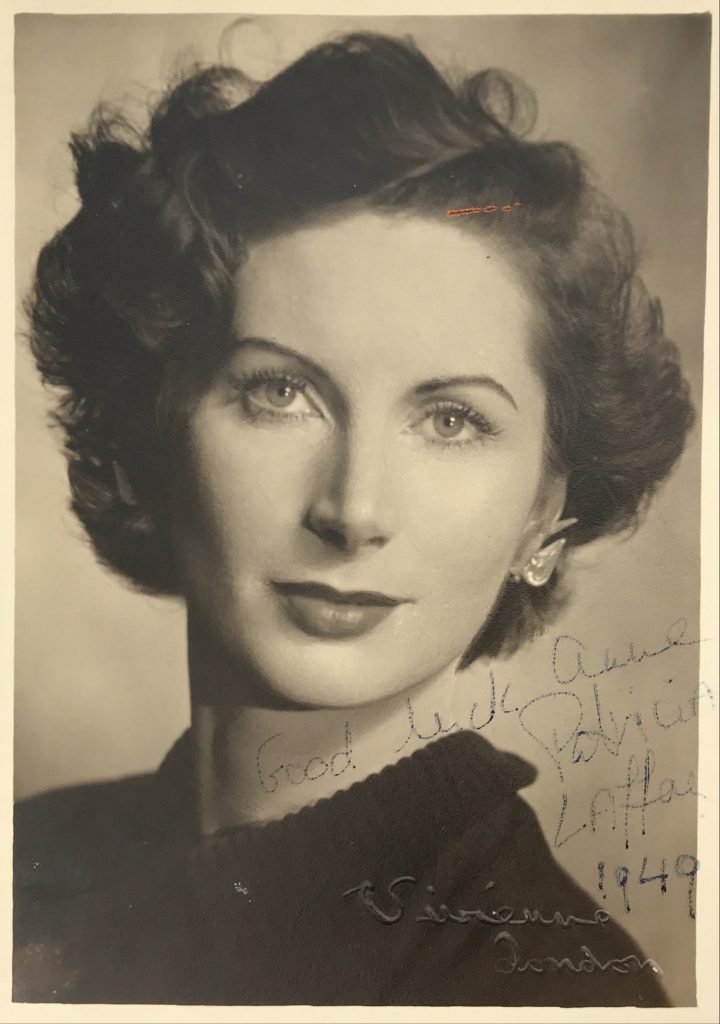
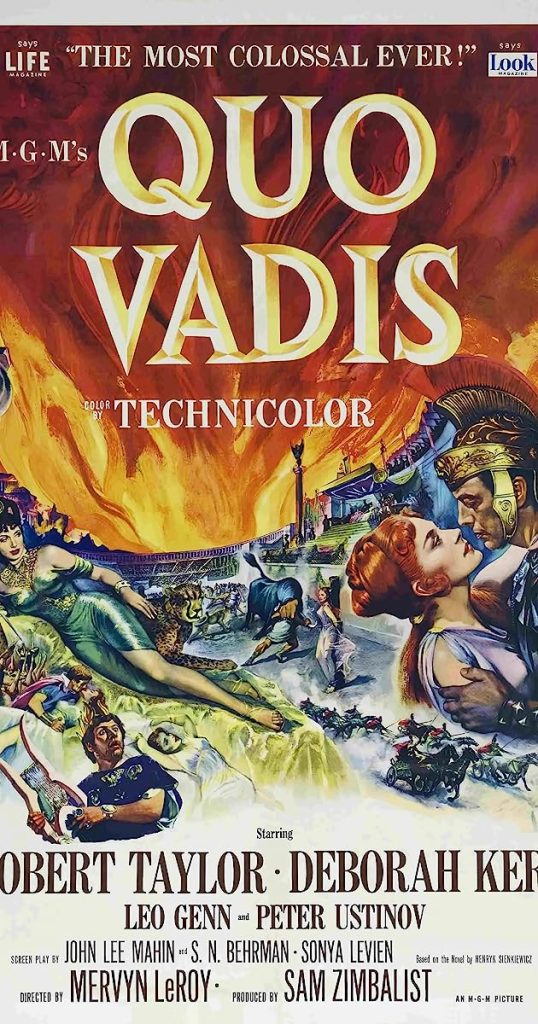
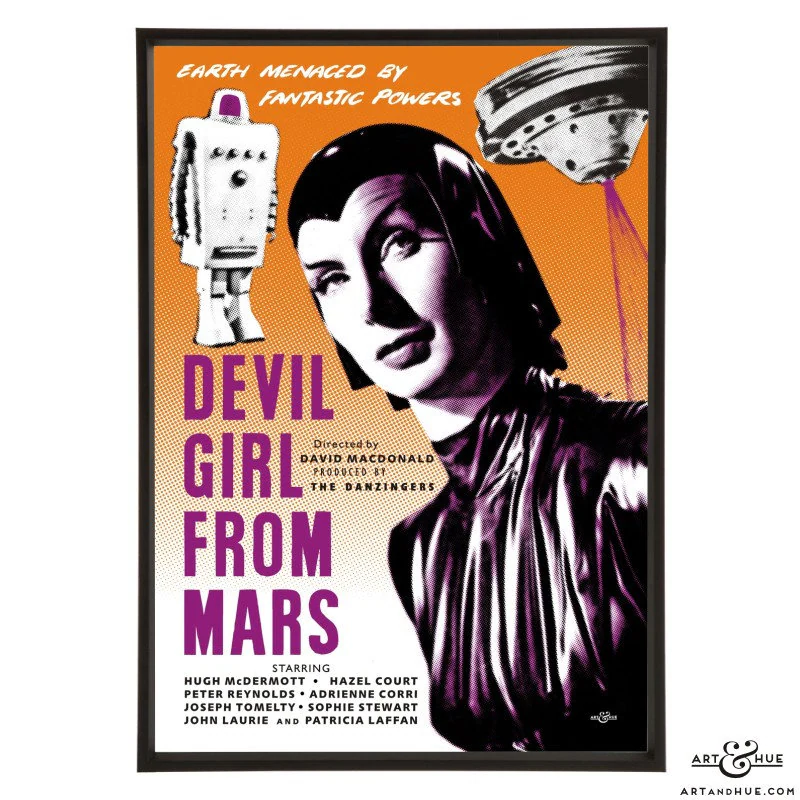
Patricia Laffan was born in 1919 in London. She is best remembered for her performance as ‘Poppaea’ opposite Peter Ustinov in “Quo Vadis” in 1951 . Her other major movies include “23 Paces to Baker Street” with Van Johnson and “Devil Girl From Mars”. She died in 2014.
Patricia Laffan
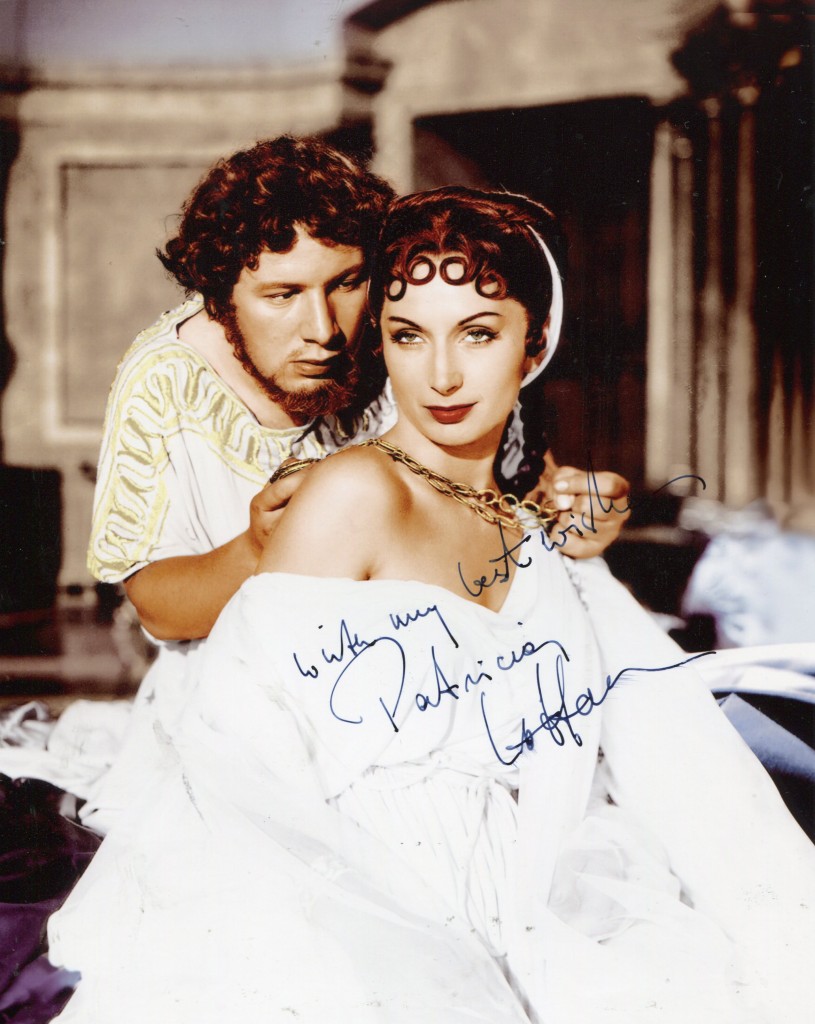
Patricia Laffan was an English stage, film, TV and radio actress, and also, after her retirement from acting, an international fashion impresario. She was five-feet-six-inches tall, with dark reddish-brown hair and green eyes.[3] She is best known for her film roles as the Empress Poppaea in Quo Vadis (1951) and the alien Nyah in Devil Girl from Mars (1954).
Patricia Laffan was the daughter of Irish-born Arthur Charles Laffan (d 1948) and London-born Elvira Alice Vitali (1896-1979). She described her father as ‘a successful rubber planter in Malaya‘. Her parents returned to the British Isles shortly before the birth of their daughter in London. On seeing the M-G-M film The Broadway Melody (1929) at the age of ten Patricia decided she wanted to act. She was educated at schools in Folkestone, Kent, and at the Institut Français in London. At the Webber-Douglas Dramatic School she studied acting. She also studied dancing at the De Vos Ballet School.
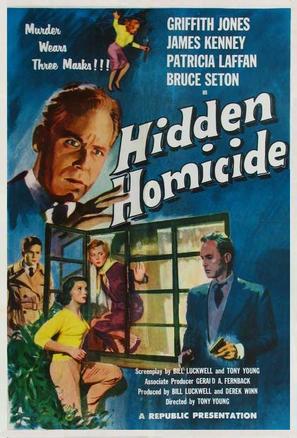
Laffan’s first film appearance was in One Good Turn (1936). She joined the Oxford Playhouse Repertory Company, and her first stage appearance was as Jenny Diver in The Beggar’s Opera (January 1937) at the Oxford Playhouse. Her first London appearance was as the Young Girl in Surprise Item (25 February 1938) at the Ambassadors Theatre. Her first credited film part may have been as a cast member in Cross Beams (1940). She toured military bases throughout England during World War II, appearing in Hay Fever and Twelfth Night. In the period 1946-1947 she appeared in six teleplays for the BBC, in which she had substantial roles and was always credited. From this point onwards her film roles were also more substantial and always credited. In 1947 she was cast with Don Stannard in the short mystery film Death in High Heels as Magda Doon, a fashion model and unintended murder victim. In 1948 she was in another short film, Who Killed Van Loon?, starring Raymond Lovell. In 1950 she appeared in the feature-length crime drama Hangman’s Wharf as Rosa Warren, a glamorous film star.
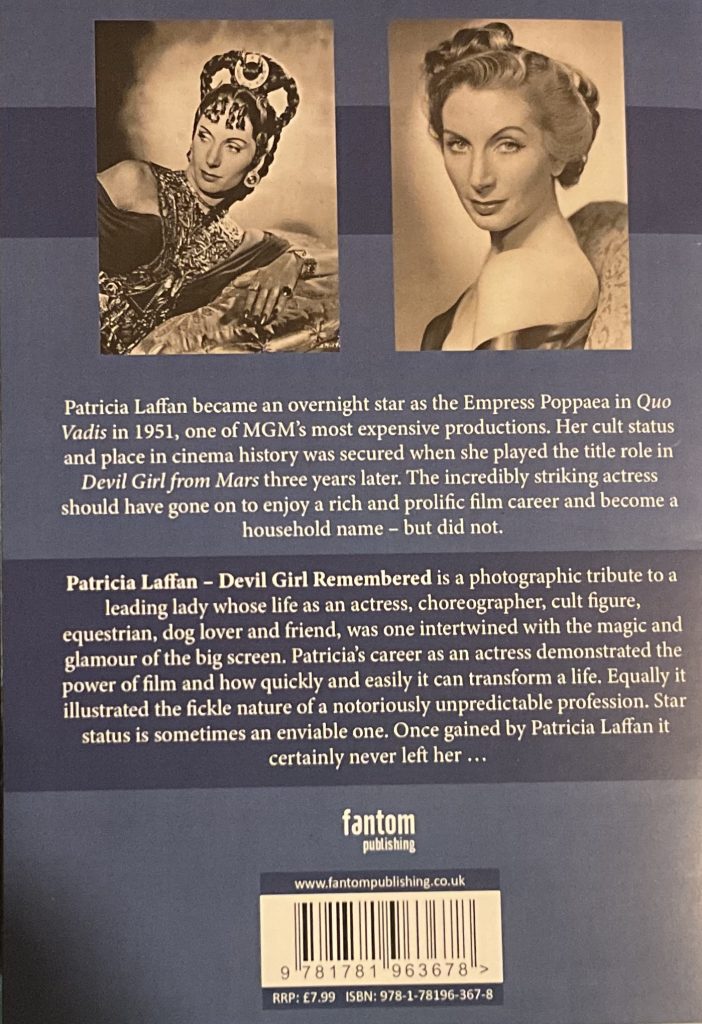
In the M-G-M Technicolor film Quo Vadis (1951) she played Poppaea, the second wife of the Roman Emperor Nero (Peter Ustinov). The producer and director of the epic blockbuster selected her for this major role after they watched a screen-test she had made for a smaller part in the film. This was her first film in colour, and it was the biggest, longest, most expensive and most commercially successful film in which she would appear. With costumes by Herschel McCoy, hairstyles by Sydney Guilaroff, jewellery by Joseff of Hollywood, and two pet cheetahs on golden leashes she was the most fabulous-looking character on the screen. Her performance as Poppaea has drawn considerable praise over the years.
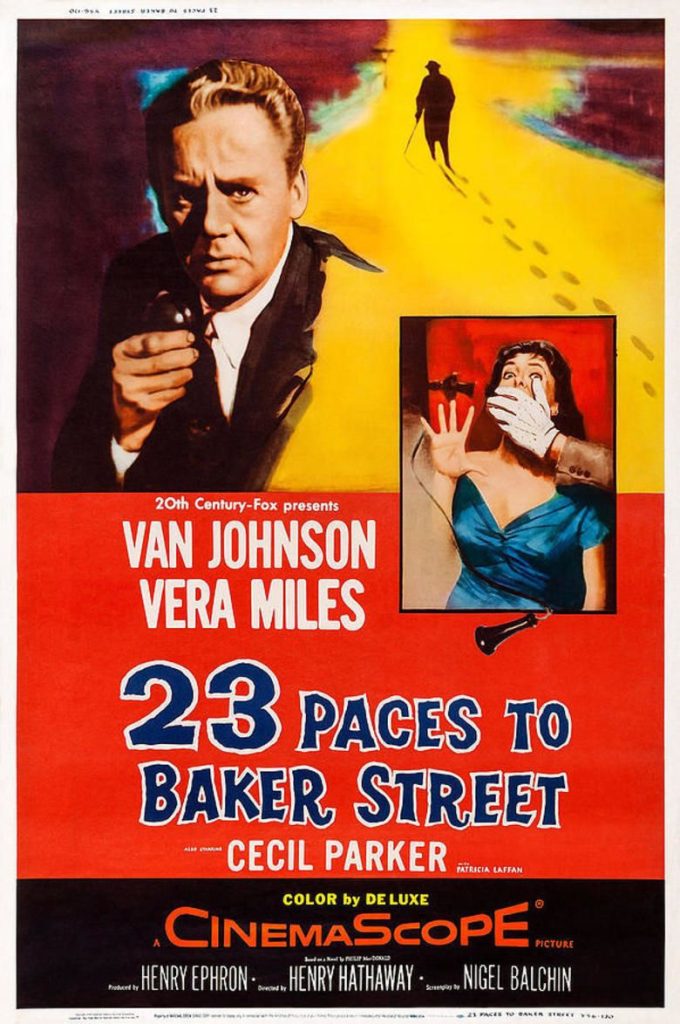
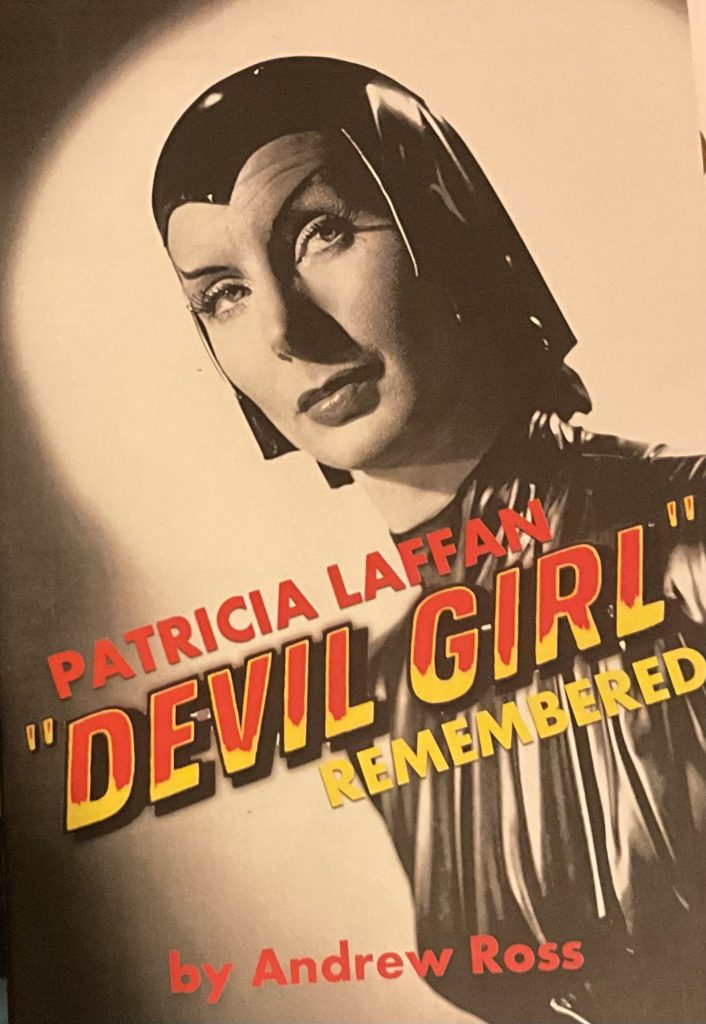
In Escape Route (1952), a crime thriller starring George Raft, she played Irma Brooks. She starred as the ruthless, PVC-clad alien Nyah in the science fiction movie Devil Girl from Mars (1954), which is now a cult classic. She had a sizeable supporting role as Miss Alice MacDonald in 20th Century Fox‘s CinemaScope mystery thriller 23 Paces to Baker Street(1956). By the 1960s she appeared mainly on radio and television, including performances in Anna Karenina, The Aspern Papers, and Rembrandt, and panel game shows such as Petticoat Line and Call My Bluff. In the late 1960s and 1970s she produced and choreographed fashion shows around the world.
The 10 July 1954 issue of Picture Show magazine featured “The Life Story of Patricia Laffan”, which included these facts:
“She lists fast cars and breeding bull terriers as her hobbies. She is quick-witted and says that had she not become an actress she would probably have been a writer. As a matter of fact, she has had a number of short stories published, and during the time she spent in Paris she wrote scripts for the Paris radio. She speaks French fluently.”[3]
Laffan had a piece printed in Winter Pie — Miscellany for Men & Women ( A Pie Pocket Special), published in October 1947. It was entitled “Penicillin and Paris” and was a breezy account of her “first weekend in Paris,” under doctor’s orders to take vitamins and a holiday. She was “wined and dined on the right bank and on the left” and broadcast (and sang Night and Day with a large band) over Radiodiffusion Francaise. There is a reference to the fact that she was appearing in the film The Rake’s Progress, then showing in Paris.
The Pittston Gazette on 20 January 1955 had an item discussing Laffan’s first visit to the United States for a combination of work and vacation. She was scouting out panel and quiz shows (she appeared in several in England) to compare notes on American methods. She noted that “The air’s so good here.” On 25 January 1956, the Daily Reporter ran an item from Louella Parsons: “Hollywood is talking about the uncanny resemblance of British actress Patricia Laffan to Gertrude Lawrence, and the interest in Patricia to play the Lawrence biography…”
Laffan was interviewed on 21 March 1998 in London by Lisa Cohen for her book All We Know (Farrar, Straus and Giroux 2012), an account of the lives of three women: New York intellectual Esther Murphy Strachey, writer-feminist Mercedes de Acosta, and British Vogue fashion editor Madge Garland. Laffan had a tangential connection to Garland: Garland was romantically involved with divorce lawyer Frances (Fay) Blacket Gill, one of the first women solicitors in England.[13] Laffan is referenced as Gill’s “last girlfriend,” and briefly discusses Gill and her relationship with Garland. In 2008 Laffan was interviewed by Matthew Sweet for the BBC 4 documentary Truly, Madly, Cheaply: British B Movies. She died at Chelsea and Westminster Hospital in London on 10 March 2014, just nine days short of her 95th birthday. The cause of death was given as multiple organ failure due to an acute kidney problem.

Comment
Linda love
Laffan was painted in 1956 by the artist Nicholas egon wish i could find the painting and where it is now only clue i have is a picture of it being painted