

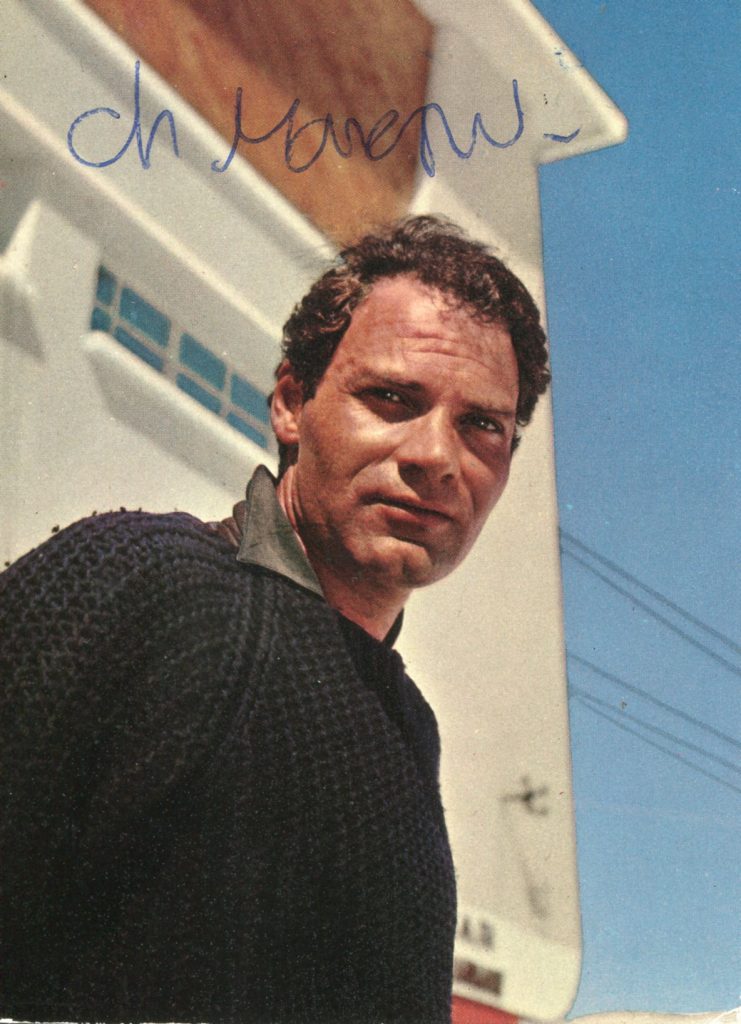
Ronald Bergan’s “Guardian” obituary from 2000:
There must have been worse ways of earning a living than passionately making love to the 22-year-old Brigitte Bardot on the beach of St Tropez. Christian Marquand, who has died aged 73, was a lucky man.The film was And God Created Woman (1956), and the steamy scene was directed watchfully by Bardot’s husband, Roger Vadim. Mostly shot on location, the rather silly, but certainly sensual, tale was a good excuse for him to display his wife’s amoral charms in various forms of dress, which mainly comprised jeans, and undress.
But the film also gave Marquand’s career a boost. Vadim’s debut movie tells of how Bardot, shortly after her marriage to a wimpish Jean-Louis Trintignant, finds she is more attractive to her dour but handsome brother-in-law, Marquand. Coincidentally in real life, Trintignant was to marry Marquand’s sister, Nadine, a few years later. But back on the beach, Bardot teases Marquand into ripping off her clothes and taking her.
The film created a scandal in France. This was mainly because of the discreet nudity of the beach scene, but Vadim complained that the censors forced him to cut the sequence.
Marquand himself was no stranger to scandal. The previous year he had a role in Marc Allègret’s Lady Chatterly’s Lover, which had starred Danielle Darrieux as the erring English aristocrat. In his private life, he married Tina, the daughter of Jean-Pierre Aumont and Maria Montez, in 1963, then had a son by the actress Dominique Sanda in the early 1970s. Thus he seemed to reflect his adulterous film persona.
One of his best pictures was Alexandre Astruc’s Une Vie (1958), based on a Guy de Maupassant story. In it, Marquand was the womanising husband of a young, innocent aristocrat, played by a cloying Maria Schell.
His affair with a friend’s wife (beautiful Antonella Lualdi) leads to his death. The main strength of the film, apart from Claude Renoir’s wonderful impressionistic Technicolor photography, was the way in which Marquand managed to find many nuances in the unsympathetic character he played.
Marquand was born in Marseilles, the son of a Spanish father and an Arab mother; the fact that he spoke Spanish, Arabic, French, English and Italian – all learned as a child – aided his international career. At the age of 21, his dark good looks got him a bit part in Jean Cocteau’s Beauty And The Beast (1946), and he was soon getting slightly bigger roles, such as the Bohemian officer friend of the caddish soldier hero (Farley Granger) in Luchino Visconti’s lush melodrama, Senso (1954).
In the 1960s, he moved with ease between films made in France and those coming out of Hollywood. Among the uninspiring latter were the D-Day epic, The Longest Day (1962), in which Marquand enlisted as part of the French contingent; Fred Zinnemann’s post-Spanish civil war film, Behold A Pale Horse (1964), in which he played a Spaniard; and, as the French doctor among the aircrash survivors, in Robert Aldrich’s The Flight Of The Phoenix (1966).
Marquand was better served by Claude Chabrol in The Road To Corinth (1967), in which he portrayed an American Nato security officer investigating mysterious boxes jamming US radar installations in Greece. In 1962, he made Of Flesh and Blood, a competent thriller featuring Anouk Aimée, and the first of two films he directed.
Marquand’s succès de scandale was Candy (1968), about the conquests of a nymphet, played by Ewa Aulin, and adapted by Buck Henry and Terry Southern from the latter’s novel. In the movie, a large international cast, including Marlon Brando, Richard Burton, John Huston, Walter Mathau, James Coburn, Charles Aznavour, Elsa Martinelli, Ringo Starr, and even the boxer Sugar Ray Robinson, did a series of star turns.
The result, according to the Monthly Film Bulletin, was that “hippy psychedelics are laid on with the self-destroying effect of an overdose of garlic”. Disappointed by this mainly negative reception, amidst the era of the love generation, Marquand returned to acting.
Tragically, in the early 1980s, however, he was struck by Alzeimer’s disease and retired from the world. He spent many of his last years in hospital, not knowing anybody who visited him. His sister, the director Nadine Trintignant, wrote a moving book about his plight, Ton Chapeau au Vestiaire (His Hat in The Cloakroom).
She survives him, as do his actor brother Serge Marquand, his former wife Tina Aumont, and his son.
Christian Marquand, actor; born March 15 1927; died November 22 2000
Christian Marquand (1927–2000) was a French actor and director whose career bridged the postwar French studio system and international 1960s–70s cinema, from Cocteau‑esque myth to war epics and absurd sex farce. He is best known for a run of 1950s star‑plus films, a handful of major Hollywood‑style war and adventure pictures, and one notorious comic‑sex‑satire film he directed, Candy, which overshadows much of his acting work in later retrospectives.
Early career and French‑cinema debut
Marquand began with a tiny, uncredited role as a footman in Jean Cocteau’s La Belle et la Bête (1946), a symbolic entry into a poetic, stylized French tradition he would later move beyond. He built up small parts through the 1940s and early 1950s, including a notable role as one of Lucrezia Borgia’s lovers in Christian‑Jaque’s Lucrèce Borgia (1953) and as an Austrian officer in Luchino Visconti’s lush historical drama Senso (1954). These early roles position him as a virile, romantic figure comfortable in elaborate costumes and heightened melodrama, already hinting at the kind of leading‑man looks that would later attract Hollywood and international producers.
Breakthrough in And God Created Woman and “French lover” image
His international profile jumped in 1956 with Roger Vadim’s And God Created Woman (Et Dieu… créa la femme), where he played Antoine Tardieu, the fisherman drawn into the magnetic orbit of the teenage Brigitte Bardot. The film’s scandalous, self‑consciously sensual beach scenes—and its association with Bardot and Vadim, then her husband—helped type‑cast Marquand as a charming, slightly louche French “lover” figure, an image critics later describe as both lucky and limiting.
The success of And God Created Woman catalysed a run of mid‑1950s and early‑1960s leading roles opposite major actresses such as Maria Schell, Jean Seberg, and Annie Girardot in films like No Sun in Venice (1957), Temptation (1959), and The Big Show (1960). In many of these, he plays a worldly, somewhat roguish man whose attractiveness and moral ambiguity put him at the center of romantic and melodramatic conflict.
Critically, these vehicles are often viewed as lightweight “Euro‑lite” dramas that showcase style and star chemistry more than deep psychological exploration, and Marquand’s performances tend to be praised more for their charm and presence than for granular emotional depth. Yet Alexandre Astruc’s Une vie (1958), an adaptation of Guy de Maupassant, is an exception; critics note that Marquand brings real nuance to Julien de Lamare, a womanising husband whose superficial charm masks a lazy, destructive egotism, and that his performance manages to make the character’s downfall feel earned rather than simply punished.
War epics, international casting, and genre work
In the early 1960s Marquand crossed decisively into Anglo‑American‑led productions, where his Frenchness could be exploited as part of the ensemble’s international flavour. Key roles include:
-
Commander Philippe Kieffer in The Longest Day (1962), a massive D‑Day‑epic that brought together dozens of stars; here he plays a real‑life French‑Commando leader, giving the picture a touch of authenticity and a more grounded, soldierly gravitas that contrasts with some of the film’s more flamboyant turns.
-
The Flight of the Phoenix (1965), where he appears as Dr. Renaud, a cultured French expert among the stranded crew, whose calm rationality and darkly ironic humour stand out in the group’s escalating crisis.
-
Behold a Pale Horse (1964), a political‑war thriller, and other international co‑productions that cast him as the “French angle” in otherwise Anglo‑American ensembles.
Critics and later commentators often see these roles as a mixed blessing: they gave him exposure alongside major stars and directors, but they also tended to keep him in the mid‑tier of the cast, valued more for his national type and his easy‑going masculinity than for sustained dramatic arcs. He becomes a kind of “continental flavour” presence—sympathetic, articulate, reliably mature—rather than a character whose inner life is fully explored.
Directorial work and Candy
Parallel to his acting, Marquand directed a handful of films, most notably Les Grands Chemins (1963), a more modest, character‑driven French drama, and Candy (1968), an absurdist, all‑star sex‑satire loosely based on the Voltaire‑narrative parody. In Candy, he assembles a cast of international figures—Marlon Brando, Ringo Starr, Walter Matthau, Tuesday Weld, and many others—around a picaresque, thinly plotted string of vignettes, with Ewa Aulin as the protagonist.
Critics have almost universally panned Candy as a tonally chaotic, self‑indulgent, and dated exercise in the male‑gaze‑driven “sex farce” subgenre, even though some concede its historical interest. From a critical‑analysis standpoint, Marquand’s direction is often read as under‑controlled: he leans heavily on the star wattage and the risqué tone, but fails to give the film a coherent rhythm or satirical edge, so that it reads more like a star‑lined catalogue of mildly scandalous set pieces than a tight satire.
Nonetheless, Candy remains the work most associated with him as a director, and its notoriety has overshadowed his more serious, if less visible, earlier direction in Les Grands Chemins and the rarely discussed adaptation of J’irai cracher sur vos tombes (1959), which he also directed. In those smaller projects he appears more invested in character and mood, though they never gained the same attention outside France.
Later roles and Apocalypse Now Redux
In the 1970s and early 1980s Marquand’s screen roles became fewer and more supporting, often appearing in international and sometimes minor‑league pictures. Among the most significant later credits is Francis Ford Coppola’s Apocalypse Now: in the re‑edited Apocalypse Now Redux version (2001), he plays Hubert de Marais, a French colonial planter whose extended monologue‑flashback sequence reflects on the Vietnam‑war‑era echo of earlier French Indochina defeat. The role is a cameo, but it carries thematic weight, using his French background and composed delivery to underline the film’s pessimistic, cyclical view of imperial folly.
He was never able to see this re‑release; he died in 2000, six months before Apocalypse Now Redux premiered, so his later legacy is partly shaped by a brief, philosophically charged part added to a film that would become a canonical Vietnam‑war text. His final performance was in a 1987 French TV mini‑series, marking a quiet return to television after a career that had wandered from art‑house‑adjacent French cinema to glossy international war and genre films.
Critical reputation and performance style
Marquand is typically remembered as a handsome, affable, but not deeply transformative leading man whose career exemplifies the transnational French actor of the 1950s and 1960s: comfortable in romance, war epics, and light‑genre fare, but rarely cast in complex, introspective roles. His strength as an actor lies in his relaxed, naturalistic charm, good comic timing, and ability to fit into international ensembles without dominating or disrupting the group dynamic.
Critically, he is often viewed as a case of promising early promise that never quite cohered into a sustained body of auteur‑style work. He was capable of real subtlety, as in Une vie and some of his smaller French roles, yet many of his best‑known vehicles are more notable for their star power, scandal, or spectacle than for their writing, which leaves his performances in those films feeling somewhat under‑served.
At the same time, he remains a useful prism through which to view the shifting image of the French “lover” and French‑commando figure in Anglo‑American cinema of the 1950s–70s: he embodies the continent’s seductive, slightly insouciant masculinity while also bringing a measure of gravitas to war‑film segments that might otherwise feel purely macho. In sum, Christian Marquand’s career is best understood as that of a mobile, adaptable leading man whose appeal was as much about presence and type as about radical reinvention, leaving a mixed but unmistakably cosmopolitan legacy across French and international cinema
Comment
Kate
That’s a great photo