

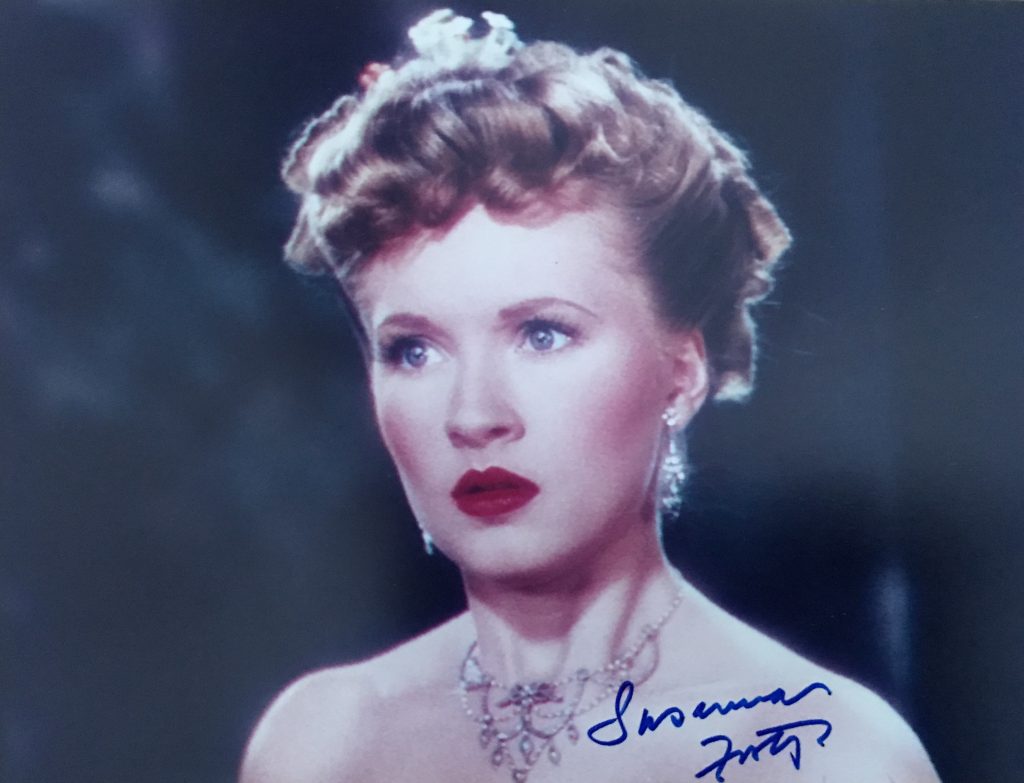
“Guardian” obituary by Ronald Bergan from 2009:
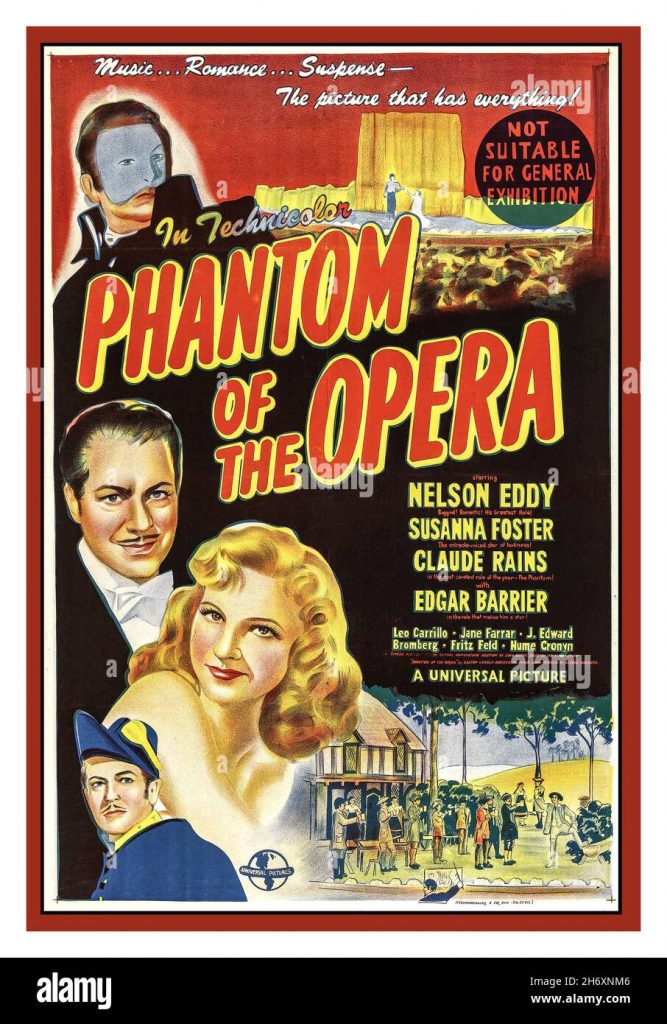
Radiating youth and beauty, and singing with an immaculate and fresh coloratura soprano voice in 11 Hollywood movies from 1939 to 1945, Susanna Foster, who has died aged 84, appeared to have everything. At the age of 19 she shone in her most memorable role as the operatic diva Christine Dubois in Phantom of the Opera (1943), which co-starred Nelson Eddy and Claude Rains. Her earnings from her Universal Studios contract enabled her to rescue her family from poverty. Yet, 13 years later, she was struggling to survive and bring up her two young sons, and her financial and mental situation worsened over the years.
Foster admitted that she was partly to blame for her changed circumstances, saying that she had made the wrong choices, including leaving films at the height of her popularity, walking out on her marriage and, when only 12 years old, turning down the title role in National Velvet because “there was no singing in it”. Eight years later, MGM’s film was to make Elizabeth Taylor a star.
Foster, who called herself a “skinny waif” at the time, was one of many well-scrubbed youngsters that MGM was grooming for stardom but, unlike Mickey Rooney and Judy Garland, with whom she was at school, she was released by the studio after a further proposition fell through. It was to be called B Above High C, a reference to the upper register of her voice.
Foster, who was born Suzanne DeLee Flanders Larson, in Chicago, and raised in Minneapolis, began to sing at the age of five, imitating the screen sopranos Grace Moore and Jeanette MacDonald. Paramount snapped her up as a teenager, casting her in the biopic The Great Victor Herbert (1939). She was a hit, playing Allan Jones and Mary Martin’s daughter, and sang Kiss Me Again brilliantly, which prompted the New York Times to write: “The charming juvenile songstress Susanna Foster is a newcomer who is going to be very bearable to watch.” After seeing Foster in the film, the newspaper magnate William Randolph Hearst flew her to his estate for a private recital for him and his mistress, Marion Davies, the former film star.
There’s Magic in Music (1941), a showcase for several young musical talents, featured Foster as Toodles LaVerne, a burlesque queen who is discovered by a priest (Jones) and brought to a music camp to perfect her singing. In this role, she not only skillfully mimicked Marlene Dietrich but also sang operatic arias from Faust and Carmen. This led Universal to offer her the part of the diva in Phantom of the Opera when the studio’s biggest star, the juvenile soprano Deanna Durbin, turned it down.
Foster, seen for the first time in Technicolor, was suitably attractive as the prima donna of the Paris opera house, loved by three men, the disfigured composer of the title (Rains), a baritone (Eddy) and a police inspector (Edgar Barrier).
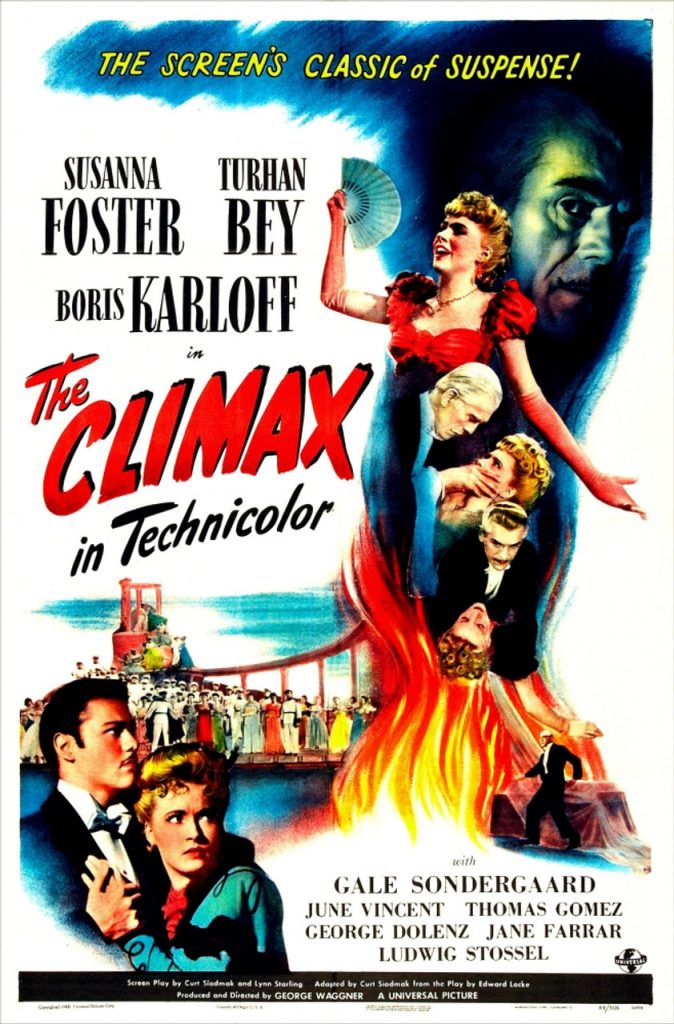
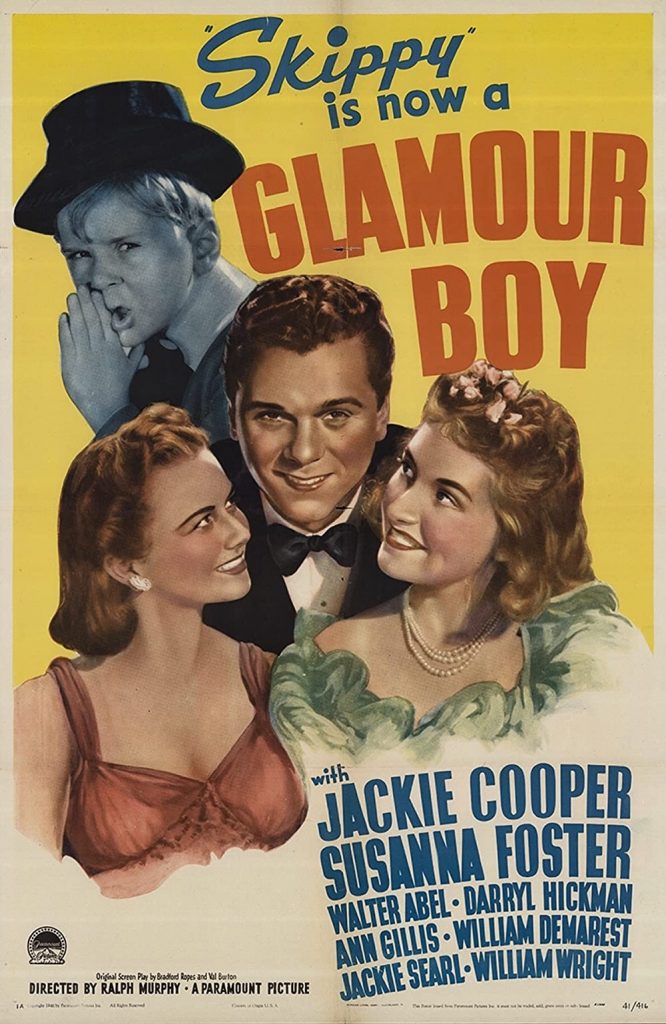
Universal then starred her opposite the energetic young dancer Donald O’Connor in Top Man (1943), a lively “let’s-put-on-a-show” teen musical, and This Is the Life (1944). Then, in Technicolor horror mode again, and in an attempt to repeat the huge success of Phantom of the Opera, came The Climax (1944), in which Foster is under the malign influence of a mad doctor, played by Boris Karloff, who wants to prevent her from singing for anyone but himself. She sings, with what one critic called “a very lusty larynx”, in arias from pseudo-operas.
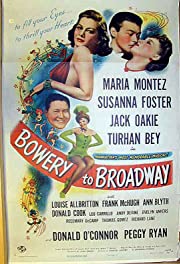
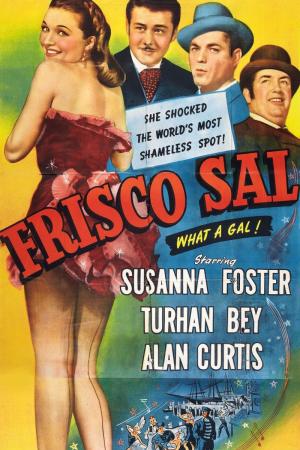
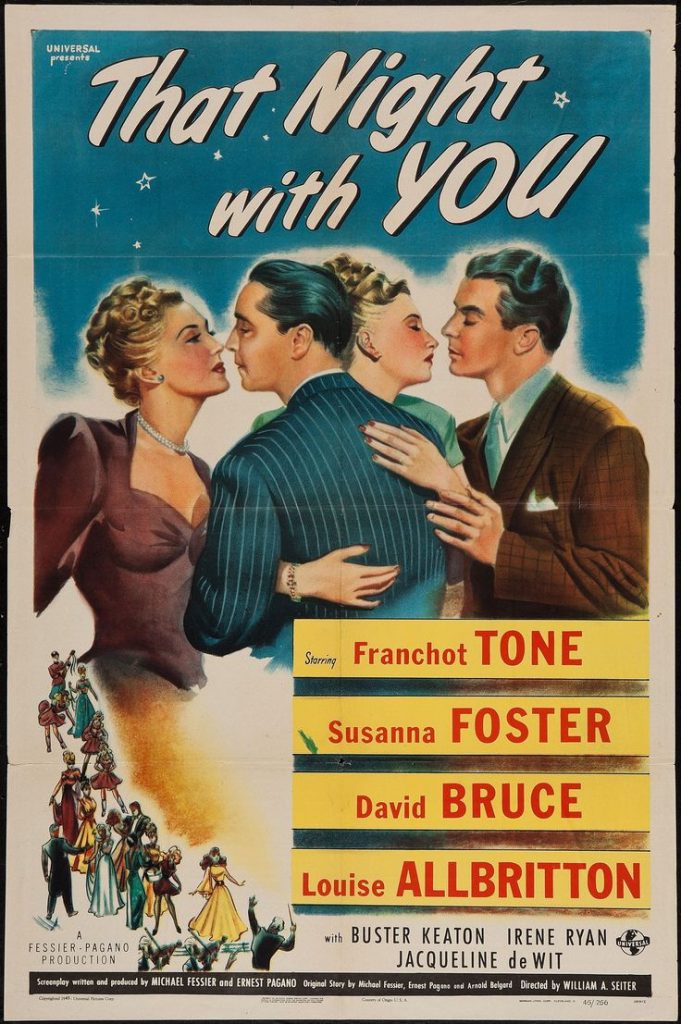
After three more films, Bowery to Broadway (1944), Frisco Sal (1945) and That Night With You (1945), Foster decided to give up show business and concentrate on her singing. In fact, Universal, hoping she would return to films, financed a six-month stay in Europe under the tutelage of the dramatic soprano Dusolina Giannini. On her return from Europe, she sang at a ball at the White House, with President Harry Truman and Eleanor Roosevelt in attendance.
In 1948, Foster made her stage debut in the Victor Herbert operetta Naughty Marietta, opposite the baritone Wilbur Evans, whom she married. They toured together in a number of operettas and musical comedies, trading on her name as a film star. However, it was Evans who got a huge break, playing Emile de Becque to Mary Martin’s Nellie Forbush in the 1951 London production of South Pacific. A few years later, Foster suddenly left Evans, who was 20 years her senior, and whom she claimed never to have loved, taking her two young sons with her.
There followed years of living on and off welfare, and from hand to mouth. While trying to ensure her children were fed, she also attempted to help her alcoholic, widowed mother and mentally unstable younger sister. Foster, too, suffered depression and had problems with alcohol. In 1982, in order to save rent, she lived in her car at the beach in California. She was rescued for a while by a film fanatic, who let her share his squalid apartment, and she later cared for him when he lost his sight. In 1985, her younger son, who had become a drug addict, died of liver failure. Her surviving son, Michael, brought her back to the east coast, where she spent the last years of her life living in a nursing home.
Remembering her glowing screen performances only adds extra poignancy to her tragic decline.
• Susanna Foster (Suzanne DeLee Flanders Larson), actor and singer, born 6 December 1924; died 17 January 2009
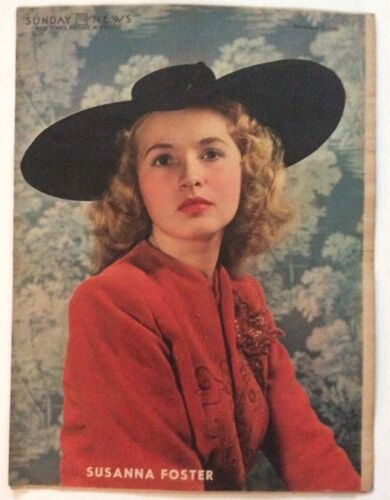
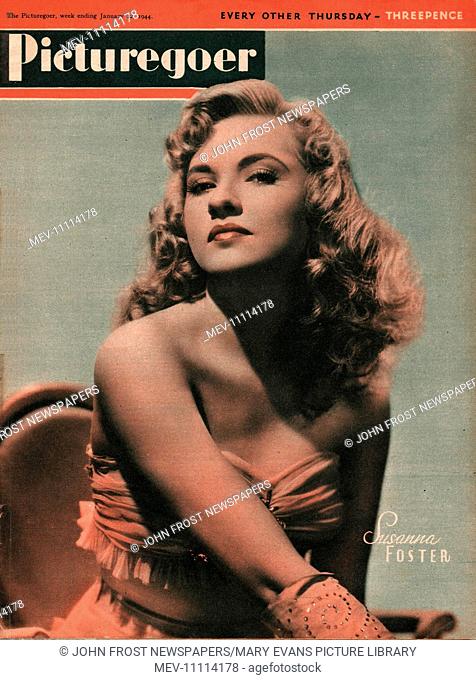
Susanna Foster (1924–2009) occupies a distinctive and poignant place in Hollywood musical history—a luminous, classically trained soprano who briefly embodied Universal Pictures’ wartime bid to blend high culture with popular cinema. Although her screen career was short, Foster’s work captured the contradictions of 1940s Hollywood: the tension between the operatic and the accessible, refinement and melodrama, artistry and marketing. Her crystalline voice, technical assurance, and poise earned her considerable acclaim in the early 1940s, yet her retreat from film by the end of the decade left her a fascinating figure—part prodigy, part cautionary emblem of unrealized potential.
Early Life and Training (1924–1940)
Born Suzanne DeLee Flanders Larson in Chicago and raised in Minneapolis, Foster showed prodigious musical ability early. Universal and MGM talent scouts noticed her before she reached adolescence—MGM briefly signed her in the late 1930s with plans to market her as a successor to Deanna Durbin. She trained intensively in classical voice and piano, developing a technique that combined conservatory precision with a light, cinema-friendly lyric tone.
Her training at MGM’s short-lived “Little Symphony” unit and early radio work gave her a polished fluency rare among teenage performers. When she moved to Paramount, then to Universal, studio publicists framed her as “the golden-voiced prodigy” capable of bridging opera and mainstream appeal. This dual identity—serious musician and romantic ingénue—would define her brief stardom.
Universal Stardom and Phantom of the Opera (1941–1944)
Universal cast Foster in her screen debut opposite Allan Jones in There’s Magic in Music (1941), also known as The Hard-Boiled Canary. It introduced her public image: an innocent girl whose pure voice redeems cynics and skeptics alike. Critics described her as possessing “a bell-like soprano reminiscent of Grace Moore but with youthful warmth.” Though the film itself was modest, Foster’s singing—particularly her performance of “Ave Maria”—attracted critical notice.
Her defining role, however, came in Arthur Lubin’s Technicolor remake of Phantom of the Opera (1943) opposite Claude Rains. As Christine Dubois, Foster’s unforced radiance and operatic discipline gave the film its centerpiece: her voice became the literal incarnation of the Phantom’s obsession. Universal promoted her as an “operatic Cinderella”—the serious musical artist amid gothic spectacle.
Critical Reception
Contemporary reviews varied but generally praised Foster’s vocal artistry:
- The New York Times called her “a delight both to the eye and the ear,” emphasizing the “warmth of tone and restraint rare in Hollywood coloratura.”
- Variety noted she “matches Rains with sincerity and youthful grace,” though some critics suggested her acting was “still inexperienced, depending on natural charm.”
Retrospective criticism (from film music historians like Miles Kreuger and Thomas Hischak) regards Foster’s Phantom as “the most credible marriage between classical singing and Hollywood narrative of its decade.” Unlike Jeanette MacDonald’s glamourized diva or Durbin’s wholesome teen, Foster’s Christine suggested a genuine musical artist. Her voice—slightly cooler in tonal color than MacDonald’s but technically secure—embodied a realism absent from most Hollywood musical fantasies.
Later Universal Work and Decline (1944–1945)
Foster followed Phantom with The Climax (1944), again directed by Lubin and again exploiting her classical voice within baroque melodrama. The film, built around discarded plot ideas from Phantom, was visually lavish but dramatically incoherent. Critics admired Foster’s arias—particularly her rendition of Mozart’s “Batti, Batti” from Don Giovanni—but the film’s weakness underscored Universal’s dependence on superficial spectacle.
By The Climax, Foster was already showing discomfort with Hollywood’s commercial compromises. Despite her vocal gifts, she was not a conventional glamour star: her manner suggested intelligence and inner life, qualities studios found difficult to market. Universal initially planned to cast her in The Strange Affair of Uncle Harry (1945), but creative conflicts and personal difficulties (including resistance to studio publicity demands) led to her departure from the studio.
Personal and Industry Context
Foster’s difficulties were emblematic of the disjunction between operatic artistry and Hollywood systemization. Studios in the 1940s prized youth and constant output; Foster, cautious about overusing her voice and disillusioned by formulaic plots, found herself labeled “temperamental.” She later suggested that her artistic seriousness was misread as noncompliance. The mismanagement of her career parallels that of Deanna Durbin, another soprano forced into repetitive “singing ingénue” roles.
Stage, Radio, and Later Career (1946–1950s)
Post-Universal, Foster appeared in regional concert tours and occasional radio broadcasts, often performing art songs and light opera arias. She reportedly declined some theatrical opportunities, including an early Broadway operetta revival, citing reluctance to commit to long runs.
Her film comeback, This Love of Ours (1945), featured her final major screen appearance. Despite a Golden Globe nomination for her performance as a devoted nurse, Foster soon withdrew from Hollywood altogether. Personal setbacks—including a troubled marriage to baritone Wilbur Evans and struggles with mental health—interrupted her career through the 1950s and 1960s.
Acting and Vocal Style: Critical Analysis
Vocal Character
Foster’s lyric-coloratura soprano was notable for its clarity, agility, and purity of intonation rather than flamboyant bravura. Where Jeanette MacDonald’s singing derived from grand-opera flair and Durbin’s from lyric lightness, Foster’s belonged resolutely to classical technique—clean resonance, focused vowels, and disciplined phrasing. Critics appreciated her ability to preserve the integrity of classical music within the sentimental framework of Hollywood narrative.
Her recordings and film excerpts demonstrate an almost instrumental precision; she sang not as a personality but as an artist channeling structure. This made her voice ideal for roles symbolizing purity or salvation but limited in popular appeal once Hollywood sought brassier, jazz-inflected styles after the war.
Acting Technique
As an actress, Foster projected sincerity and intelligence but limited emotional range. She depended on vocal nuance and gaze rather than physical expressiveness. In Phantom, this translucence suited the archetype of Christine—the muse rather than the woman—but in lesser scripts it read as reserve. Some critics found her too statuesque; others praised her lack of affectation. With better direction, her mixture of fragility and authority might have matured into something akin to Ingrid Bergman’s quiet conviction.
Thematic Consistency
Her on-screen persona consistently fused:
- Innocence allied with artistic purity: the singer as moral center.
- Aesthetic aspiration over romantic fulfillment: she usually embodies art’s redemptive power rather than personal desire.
- Cultural refinement within mass cinema: an effort (on Universal’s part) to elevate the studio’s horror/melodrama brand to high art.
Later Life and Legacy
Foster’s later years were marked by obscurity and hardship, but renewed attention to Phantom of the Opera (1943) in repertory screenings and home video resurrected interest in her artistry. Modern critics, including film historian Scott MacQueen, describe her as “the true musical soul of the Universal technicolor period—an artist trapped in a factory.”
In the context of Hollywood musical history, she bridges the era between Jeanette MacDonald/Nelson Eddy operettas of the 1930s and the MGM postwar Technicolor spectacles. She also served as an artistic counterpoint to Deanna Durbin: whereas Durbin represented wholesome optimism, Foster personified the fragile ideal of art itself within mass entertainment.
Critical Summary
-
Strengths:
- Exquisite vocal technique; one of the screen’s few authentic operatic sopranos.
- Poised, sincere presence aligning classical artistry with cinematic accessibility.
- Central performance in Phantom of the Opera (1943) still cited as one of the most musically credible in American film history.
-
Limitations:
- Narrow acting repertoire tied to ingénue purity; limited opportunities for emotional development.
- Career undermined by studio indecision and the postwar decline of operatic taste in cinema.
- Personal and psychological fragility amplified by the rigid studio system.
Legacy
Susanna Foster remains a symbol of an artistic bridge no studio could sustain: the fusion of operatic integrity with Hollywood narrative glamour. Her truncated career has gained increasing admiration from historians who view her as an early casualty of Hollywood’s inability to nurture genuine musical artistry beyond marketable formula.
While she appeared in only a handful of pictures, the purity of her craft endures—her Christine Dubois standing as a rare Hollywood heroine portrayed not through sexuality or comedy, but through the disciplined grace of art itself