

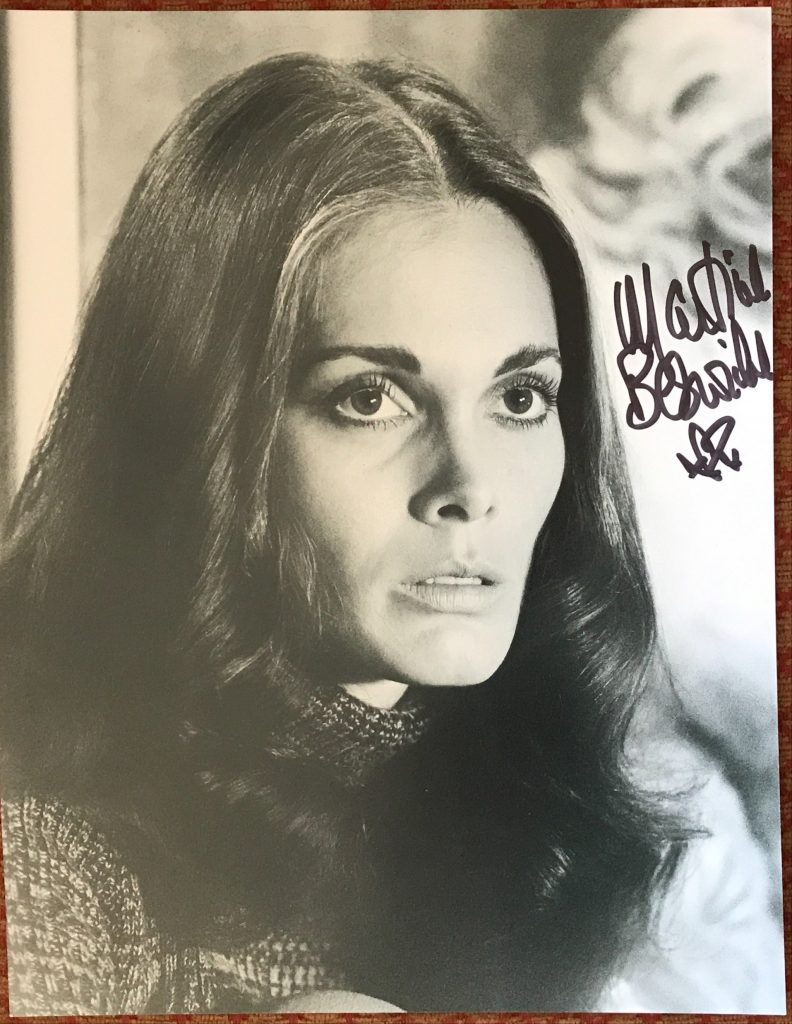
Martine Beswick

Martine Beswick

Beswick was born on 26 September 1941 in Port AntonioJamaica to Ronald Stuart Davis Beswick, a British father and Myrtle May (néePenso, 1912-2017) a Portuguese-Jamaican mother.

Beswick, her sister Laurellie (1943-2002) and her mother moved to London in 1954 following the separation of her parents. In 1955, she left high school to work to help support her family.

Beswick is best known for her two appearances in the James Bond film series. Although she auditioned for the first Bond film Dr. No, she was cast in the second film From Russia with Love as the fiery gypsy girl, Zora. She engaged in a “catfight” scene with her rival Vida (played by former Miss Israel Aliza Gur). She was incorrectly billed as “Martin Beswick” in the title sequence.  Beswick then appeared as the ill-fated Paula Caplan in Thunderball. She had been away from the Caribbean so long that she was required to sunbathe constantly for two weeks before filming, to look like a local.

Beswick went on to appear in One Million Years B.C. opposite Raquel Welch, with whom she also engaged in a catfight. She then appeared in various Hammer Studio low-budget films, most notably Prehistoric Women and the gender-bending Dr. Jekyll and Sister Hyde, in which she played the titular villainess. She played Adelita in the well-regarded Spaghetti WesternA Bullet for the General (1966) opposite Klaus Kinskiand Gian Maria Volonté. She starred as the Queen of Evil in Oliver Stone‘s 1974 directorial debut Seizure, or Queen of Evil. In the 1970s, Beswick moved to Hollywood and regularly appeared on both the big and small screens. She made numerous guest appearances on television series, including Sledge Hammer!Fantasy IslandThe Fall GuyMannixThe Six Million Dollar Man and Falcon Crest. In 1980, she played the lead role in the comedy film The Happy Hooker Goes Hollywood.

Beswick’s career was active well into the 1990s. Since then, she has mainly participated in film documentaries, providing commentary and relating her experiences on the many films in which she has appeared. She owned a removals business in London, but is now semiretired except for her guest appearances at international Bond conventions.

In April 2013, she was one of 12 Bond Girl celebrity guests in an episode of the BBC‘s Masterchef.

Beginning with Melvin and Howard (1980), she changed the spelling of her last name to “Beswicke”, but reverted to her original name in the mid-1990s; her last credit with the longer spelling is Wide Sargasso Sea (1993).

After a 24 year absence from the screen, Beswick came out of retirement in 2018 to star in House of the Gorgon opposite fellow Hammer film stars Caroline MunroVeronica Carlson, and Christopher Neame.

Martine Beswick (born 1941) occupies a unique space in cinema history as the ultimate “cult” actress. Moving from the high-glamour world of James Bond to the gritty avant-garde of 1960s counter-culture and Hammer Horror, she became a symbol of a new, fierce femininity that challenged the traditional “damsel in distress” tropes of the era.

Career Overview

Beswick’s career is defined by its international flavor and a refusal to stay within the “starlet” box.

  • The Bond Breakthrough (1963–1965): Born in Jamaica, Beswick famously appeared in two different James Bond films as two different characters. In From Russia with Love (1963), she was the gypsy girl Zora (famous for the brutal “catfight” scene), and in Thunderball (1965), she played the ill-fated operative Paula Caplan.

  • The Hammer Horror Icon (1966–1971): She became a muse for Hammer Film Productions, starring in One Million Years B.C. (1966) alongside Raquel Welch. Her most critically acclaimed role of this era was the lead in Dr. Jekyll and Sister Hyde (1971), a subversive reimagining of the classic tale.

  • The Avant-Garde and “New Hollywood”: Beswick moved to the U.S. and became a favorite of independent filmmakers. She starred in the surrealist Western El Topo (1970) and played a significant role in the cult classic The Nine Lives of Fritz the Cat (1974).

  • Television and Legacy: Throughout the 80s and 90s, she transitioned into a reliable television guest star (The Fall GuySanta Barbara) and became a beloved fixture of the international fan convention circuit, recognized for her intelligence and candidness about the industry.


Detailed Critical Analysis

1. The “Physical” Actress

Critically, Beswick is analyzed for her athleticism and animalistic grace. In an era where many actresses were directed to be “decorative,” Beswick brought a palpable physical threat to her roles.

  • The Catfight (1963): Her fight with Aliza Gur in From Russia with Love is still studied by film historians. Unlike the “slap-fights” common in 1960s cinema, Beswick’s performance was grounded in a raw, gritty physicality that suggested genuine danger.

  • The Warrior Archetype: In One Million Years B.C., she played Nupondi. While the film was marketed on glamour, critics noted that Beswick possessed a “feral” energy that felt more authentic to the prehistoric setting than her co-stars.

2. Gender Subversion in Dr. Jekyll and Sister Hyde

This film remains the cornerstone of Beswick’s critical legacy.

  • The Mirror Image: Cast as the female incarnation of Ralph Bates’ Dr. Jekyll, Beswick had to embody a masculine mind in a feminine body. Critics praised her for not playing “a woman,” but playing a “man-becoming-woman.”

  • The Predatory Feminine: She portrayed Sister Hyde with a cold, aristocratic cruelty. It was a groundbreaking performance in the horror genre, as it moved away from the “victim” role and presented a female antagonist who was intellectually superior and physically lethal.

3. The “Exotic” Label vs. Reality

Because of her Jamaican heritage and striking features, Beswick was often cast as “exotic” characters (gypsies, islanders, prehistoric women).

  • Transcending Stereotype: Critically, she is noted for how she used these roles to project agency. Even when playing characters with little dialogue, she utilized a piercing, intelligent gaze that commanded the audience’s attention.

  • The Modern Persona: In her later work, particularly in independent films, she shed the “exotic” costumes and revealed a sophisticated, dryly witty urban persona that the mainstream studios had largely ignored.

4. Cultural Impact: The Anti-Bond Girl

While many “Bond Girls” of the 60s faded into obscurity, Beswick’s reputation has only grown.

  • Resilience and Range: Critics point out that she survived the “Bond curse” by diversifying her roles. She was one of the few actresses of the period who could convincingly move from a blockbuster spy movie to a low-budget, experimental art film like El Topo.

  • A Symbol of the 60s Shift: She represents the transition from the “prim and proper” 1950s woman to the sexually liberated, physically capable woman of the late 1960s.


Major Credits & Recognition

Project Role Significance
From Russia with Love Zora The definitive cinematic “catfight” that launched her career.
Thunderball Paula Caplan Rare instance of an actress being cast twice in the same franchise.
Dr. Jekyll and Sister Hyde Sister Hyde Her most complex dramatic and psychological performance.
One Million Years B.C. Nupondi Cemented her status as a physical, “action-ready” star.
El Topo Mara Her entry into the world of avant-garde cult cinema

Leave a Reply

Your email address will not be published. Required fields are marked *